


Atlantic Transport News – February 2022

Welcome to the February 2022 installment of Atlantic Transport News!

Here’s a look at what you’ll find in this edition:

VIA HOLDS “MARKET DAY” FOR LONG-HAUL EQUIPMENT SUPPLIERS

One of the first of VIA’s new Siemens Charger locomotives and its consist of Venture rolling stock undergoes real-world winter testing during a snowstorm on the Alexandria Sub near Ottawa in January. The long-haul version of this engine will no doubt be in contention to replace an aging fleet of GMD F40s, now in their fourth decade of active service. PHOTO – David McCormack

VIA Rail Canada has confirmed it is preparing a business case for the renewal of its aging long-haul locomotives and cars – some of which are more than 70 years old. The Crown corporation hosted a virtual “Market-Day” event with suppliers on January 20 to discuss the project and seek their input on various elements including schedule, budget, procurement and delivery timeline. Those discussions will inform the submission to the federal government, which will ultimately have to approve the necessary funding. The latest version of VIA’s 5-year Corporate Plan, which has just been released to the public, is rather pessimistic on how long the process will take, suggesting that delivery of new equipment may well be 10-15 years in the future.

VIA is being somewhat coy about which potential suppliers might be involved. The invitation posted in December on the MERX public tendering website was extended to “all tier 1 original equipment manufacturers of intercity and long-distance rail cars and locomotives”, adding that the day would be dedicated to both informing the market about the fleet renewal opportunity and addressing the context of the Government of Canada’s 2022-2023 Budget.

A spokesperson in the office of CEO Cynthia Garneau did say the participating suppliers at the market day came from “across the world”, but was not in a position to say how many there actually were. However, it’s a safe bet that Siemens Mobility will be among the contenders to at the very least build new locomotives. Siemens is already supplying 32 bi-directional trainsets to replace VIA’s entire corridor fleet by the end of 2024. The first of these is currently undergoing testing in real-life winter conditions on the Alexandria Sub between Ottawa and Coteau QC. The first revenue service is set to take place later this year. The testing is reportedly going well.

Each of the new VIA trains includes a Siemens Charger locomotive, the current state-of-the-art in low-emission diesel-electric traction. The company also builds a long-distance version of the Charger. As of February 8, Amtrak now has a total of 125 of the so-called ALC42 units on the way, having just exercised an option to add 50 more to its current production order.

The ALC42 boasts a 1000-kilowatt head-end power capability for car heating and hotel services, compared to 600 kilowatts on the ones in VIA’s current order, as well as 20% more fuel capacity for longer range. Amtrak has had the first two units for testing over the past six months, and they’ve just been placed in revenue service on the Chicago-Seattle Empire Builder.

Meanwhile, the union representing many of VIA’s employees wants Ottawa to pour “significant dollars” into the corporation’s long-haul fleet renewal, and it views the Halifax-Montreal Ocean as a priority.  Unifor spokesperson Scott Doherty told the Campbellton Tribune that upgrading passenger rail transportation is a key factor across the country. He said that the Trudeau Government needs to follow the lead of the Biden White House, which as just committed to the largest public investment in Amtrak’s entire history.

“It can’t just be fast rail service from Toronto to Ottawa or Montreal to Windsor,” he said. “That can’t be the only place where investments get made.” He added that rail travel is “a green, environmentally acknowledged form of transportation, and it’s got to be affordable.”

 -Ted Bartlett

HALIFAX AIRPORT TRAFFIC “STALLED” IN 2021
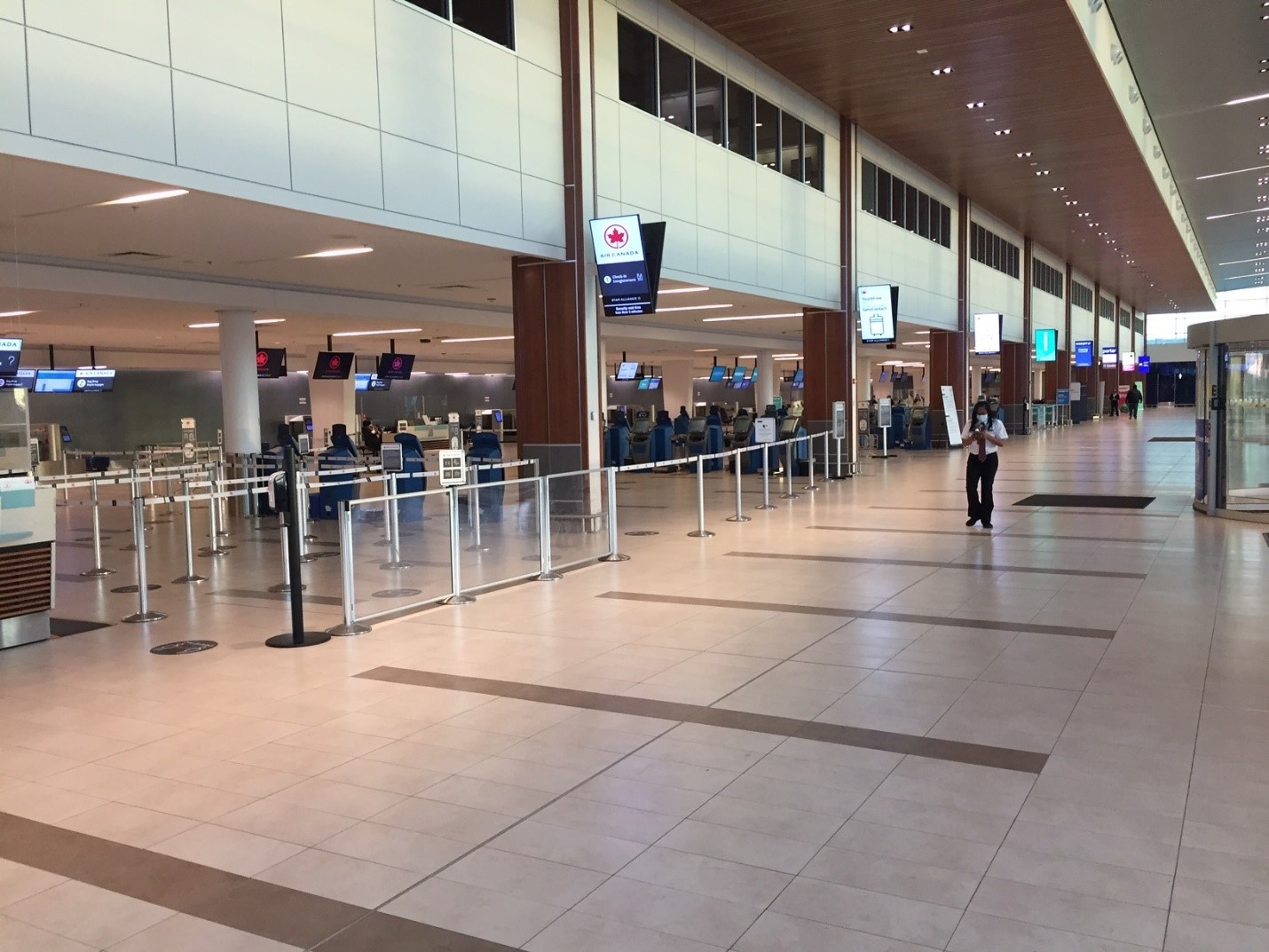
This view of the main departures concourse at Halifax Stanfield International Airport on a November afternoon in 2021 was all too typical of the feeling of emptiness that prevailed here and at other terminals throughout the region last year. PHOTO – Ted Bartlett

2021 was another turbulent year for air traffic through Atlantic Canada’s busiest airport. For the second year in a row, passenger activity at Halifax Stanfield airport was down roughly 75 per cent compared to pre-pandemic levels. 1.1 million passengers travelled through the airport in 2021, compared to 4.2 million passengers in 2019.  Domestic travel reached roughly a third of 2019 levels in 2021, but US and international travel was nearly non-existant due ongoing international travel restrictions, and limited direct international flights to and from Halifax. This has resulted in significant financial losses for the Halifax International Airport Authority (HIAA).

“The past two years have been the most challenging years in Halifax Stanfield’s history,” said Joyce Carter, President and CEO, HIAA, in a news release. “We anticipate that it will take several more years for the airport to fully recover from the effects of COVID-19, and the recovery path will have many ups and downs along the way.”

After a slow start to the year, travel began to pick up through the late summer, as travel restrictions eased, and increasing vaccination rates helped raise traveller confidence. The return of air service created a sense of optimism, and more passengers were served during the month of August than the months of January to July combined. However, much of this progress was blunted by the pre-Christmas spike in COVID-19 cases due to the Omicron variant and restored caution against non-essential travel.

The overall decrease in passenger traffic during the pandemic has had a significant financial impact on the HIAA, airlines, and other businesses connected to the airport, including food, beverage, and retail concessions. According to a news release from the HIAA, approximately 45 per cent of concessions in the air terminal building remain closed because of the low passenger volumes, while others have reopened on limited hours due to less frequent flight activity and ongoing labour shortages.

Other airports throughout the region reported similar news, while also looking ahead with some cautious optimism. St. John’s International, Atlantic Canada’s second largest in terms of passenger numbers, has yet to release statistics for 2021, but Greater Moncton’s Roméo LeBlanc Airport – number three in the region – confirmed that its passenger arrivals and departures showed only slight improvement from the previous year.

In a media release on February 7, the airport authority acknowledged the uncertainty hanging over YQM in 2021. Even though it was the only New Brunswick airport handling passengers during the first half of the year, the facility saw only 10% of normal activity during that period.

A stronger recovery over the summer months meant that YQM was able to close the year at 177,040 passengers – a slight improvement over the prior year’s total of 173,404. Still, this remains down 74% compared to pre-COVID 2019 activity levels of 674,406 passengers.

-Tim Hayman, with files from Ted Bartlett

ST. JOHN’S AIRPORT PARALYZED BY FIREFIGHTERS DISPUTE

Chris Bussey, regional vice-president of the Union of Canadian Transportation Employees, said St. John’s Airport firefighters complained about harassment and bullying after bringing health and safety concerns to their employer. PHOTO – Jeremy Eaton/ CBC

It was neither a consequence of COVID nor winter weather, but for a four-day period in mid-January the region’s second busiest airport was brought to an effective standstill. The issue was a long-festering labour dispute with firefighters at St. John’s International Airport.

The first flight cancellations came on January 17, after two-thirds of fire hall staff went on leave due to concerns about what they claimed was a toxic workplace. Chris Bussey, the regional vice-president of the Union of Canadian Transportation Employees, told CBC News that firefighters were complaining about harassment and bullying after bringing health and safety concerns to their employer. Mr. Bussey said his members had reached a point where they had nowhere else to turn.

He said six out of nine firefighters asked their family doctors to take them out of the workplace to “protect their psychological health and safety”, leaving just three to respond to potential emergencies. He noted that airport firefighters require specialized training under international aviation regulations, which means staff can’t be supplemented by the St. John’s Regional Fire Department. At that point there was only one firefighter with one crash truck serving the airport – a service level sufficient for small planes, like a Dash 8, but not for larger aircraft.

A spokesperson for the St. John’s International Airport Authority confirmed operations had been affected by staffing levels, but declined to specifically address the issues with the media. By next day YYT was essentially at a complete standstill, except for medevac and cargo flights. For obvious geographic reasons, St. John’s is arguably more dependent on its airport than any other Canadian city of comparable size. Federal Labour Minister Seamus O’Regan, who represents one of the city ridings, said he was working with Transport Minister Omar Alghabra to try to find a resolution.

It took several days of apparently-intense negotiation with the aid of senior federal mediator Barney Dobbin, during which time a limited number of flights were able to operate under an interim arrangement, while others were diverted to Gander. A cryptic media release from the airport authority late on the fourth day of the disruption announced that the matter had been resolved and normal operations could now be resumed. Without giving any details, the statement said only that the issues had been addressed, adding that “we are committed to work with the union to ensure that this does not reoccur.”

It was several days more before flight schedules had fully returned to their COVID-reduced normal levels.
-Ted Bartlett

CAT TO SET SAIL FROM YARMOUTH AGAIN IN 2022
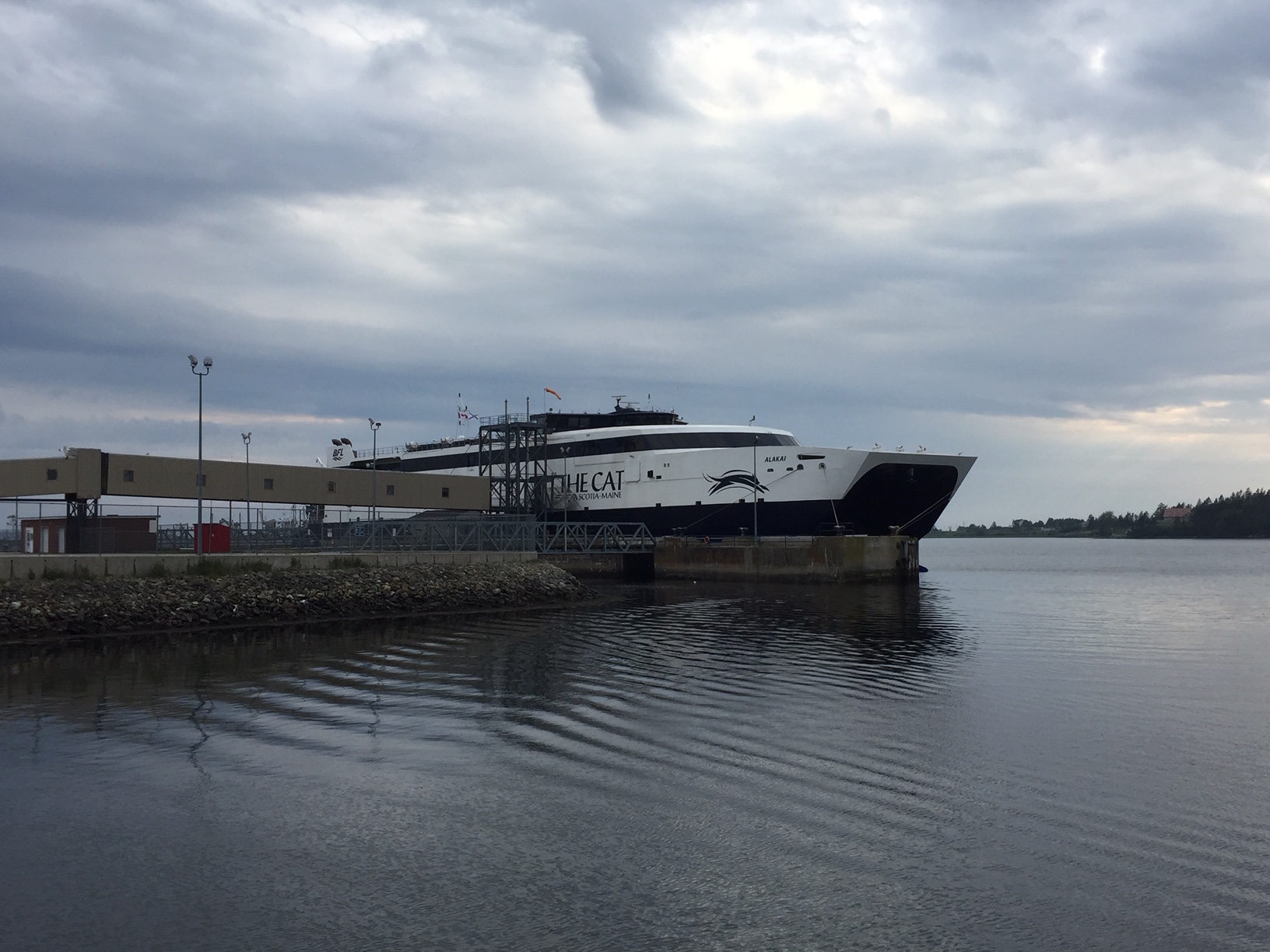
After more than three years of inactivity, the CAT may be about to resume service from Yarmouth NS. PHOTO – Tim Hayman

After yet another year out of service due to ongoing pandemic related travel restrictions, Bay Ferries is finally anticipating a return to service for the much maligned CAT ferry between Yarmouth and its new terminus of Bar Harbor, Maine. The company has announced a service resumption date of May 19, beginning with four crossings a week – Thursday, Friday, Saturday, and Monday. The service will expand to daily crossings from June 23 to September 11, dropping to six days a week until October 10, when sailings will end for the season.

The ferry will depart from Yarmouth at 9:30am, and depart for its return trip from Bar Harbor at 3:00pm. The shorter schedule facilitated by the new US terminus, at 3 ½ hours, makes this tighter turnaround possible, and facilitates better scheduled times in each direction. Tickets for the season can be booked via the Bay Ferries website. Adult fares are $115 one-way for walk-on passengers, or $210 for a round trip ticket, with discounted rates for seniors and youths; children under 6 years of age are free. Vehicle fares begin at $199 for a standard car, with increasing rates for larger vehicles and trailers, added to the initial passenger fare. Fares for smaller vehicles are lower, beginning at $20 for a bicycle. A special “Atlantic Adventure” package is also available, which offers discounted rates for walk-on round-trip travel where both crossings are completed within 72 hours. Canadian passengers may be disappointed to realize that all fares are presented in US funds, which means that the ferry pricing will be much steeper for Canadians depending on the exchange rates.

As with any travel in this time, scheduling and the actual return to service remain contingent on the public health situation, and any cross-border travel restrictions that may exist or evolve as the year unfolds. Full refunds are available on any trips cancelled at least 24 hours before departure.

FOOT-DRAGGING ON CAMPOBELLO FERRY ISSUE “OUTRAGEOUS”, SAYS NEW BRUNSWICK’S NEWEST SENATOR

Former Port Saint John CEO Jim Quinn is the newest member of the Senate from New Brunswick, and he intends to take an active role on transportation matters – including the Campobello ferry. SUBMITTED PHOTO

The normally-seasonal ferry serving Campobello Island has received yet another extension – this time until May. Scheduled to tie up for the season at the end of December, the tug-and-barge operation linking Campobello to the New Brunswick mainland via Deer Island is continuing to run four days a week, weather permitting and at the discretion of the operator. The Department of Transportation and Infrastructure foots the bill, which is about $60,000 a month.

Reaction among the island’s 800 permanent residents was generally positive, even though it’s widely recognized that the current ferry is poorly suited to the task at hand for a variety of reasons, not the least of which is that it was never designed for operation under winter conditions. Advocates are seeking a permanent, year-round solution with a more suitable vessel that ensures residents won’t have to travel through the US to access services in mainland New Brunswick. The Province has balked at the idea, maintaining that the island has a bridge to the state of Maine, and the federal government has so far refused to come to the table – even though an ACOA-funded study identified clear economic benefits from a year-round ferry, both to the island and the province as a whole.

It’s a situation that the province’s newest member of the Red Chamber in Ottawa finds “outrageous”. In a wide-ranging virtual discussion with a delegation from Transport Action Atlantic, Senator Jim Quinn said it’s a matter he’s prepared to pursue, and that a situation like this just wouldn’t happen in a part of Canada considered more politically important. He’s in a good position to know, having served many years as a senior federal public servant before becoming CEO of Port Saint John.

Senator Quinn is a member of the non-partisan Canadian Senators Group. He’s supportive of many of the issues on TAA’s sustainable transportation agenda.
-Ted Bartlett


REMEMBERING TWO ATLANTIC TRANSPORTATION LEADERS

Two prominent industry personalities from the late 20th Century, have passed away in recent weeks. Harry Steele and Rupert Tingley were both in their 90s. Mr. Steele, who died in St. John’s on January 28, has been widely described as a business titan. He achieved initial fame at Eastern Provincial Airways –“the little airline that could” – and served as chairman of Canadian Airlines International for over a decade. Mr. Tingley passed away in Moncton on February 2. He was a railroader whose career track led him down to the sea, whose name was synonymous with ferry service in Atlantic Canada for 15 years.

Lieutenant Commander Harold R. Steele was a career navy man, whose final military posting placed him in command of CFS Gander, not far from his birthplace in the remote Newfoundland outport of Musgrave Harbour. While there, he and his business-savvy wife Catherine acquired a bankrupt hotel named, perhaps somewhat inappropriately, the Albatross. By the time he left the forces in 1974 the hotel was doing well, and he accepted an offer as a vice-president with Eastern Provincial Airways, then part of the Crosbie group of companies. He lasted less than a year in that job – but long enough to recognize the struggling airline as an opportunity.

Harry Steele acquired control of struggling Eastern Provincial Airways in 1978, turned it around in just four years, and sold it to Canadian Pacific at a handsome profit. Before exiting the transportation business completely in the late 1990s, his interests also included stakes in Halterm, Oceanex, and Clarke Transport. PHOTO – Langan Business Report

The Steeles mortgaged their home and the hotel to augment the money they’d earned in some astute stock market trades, and by 1978 had acquired control of EPA. He turned it into a money maker, built a reputation for customer service and satisfaction, played politics and overcame the Transport Canada bureaucracy to defeat the much-larger CP Air in a struggle to win the lucrative Halifax-Toronto route, and took on striking pilots in a bitter and very public dispute. (During the labour troubles, Harry Steele was widely quoted as referring to the strikers as “overdressed, overpaid, oversexed bus drivers” – something he always maintained he never said – but the legend persists to this day.)

He also lost some friends in Newfoundland, and Gander in particular, by moving the airline’s operational hub to Halifax. It was a sound economic decision in light of the new Toronto routes, and no doubt facilitated the sale of EPA to CP Air at a substantial profit in 1984.

Mr. Steele was soon named to the board of CP Air, and eventually became non-executive chairman of Canadian Airlines International. But his aspirations to lead the new carrier into an enduring national and world-wide presence came to naught. Battered by the turbulent skies of the 1990s, Canadian ceased to exist with the arrival of the new millennium, and was acquired and merged into Air Canada. In later years, Harry Steele’s business focus was in broadcasting, but it was said he always refused on principle to fly Air Canada. At the time of his death, the Albatross Hotel was still in the family.

Rupert J. Tingley, shown here front and centre with his senior management group, was named Marine Atlantic’s first president and CEO when it became an independent Crown corporation in 1986. He was previously V-P and general manager of East Coast Marine and Ferry Service and CN Marine from 1973. PHOTO – Marine Atlantic Archives

Rupert J. Tingley, a native of Petitcodiac NB, also served in Canada’s military as a member of the RCAF. On release from the service he attended the University of New Brunswick, earned his engineering degree, and like many young New Brunswickers of the postwar era found employment with Canadian National Railways in 1952. His assignments around Atlantic Canada involved him in a number of marine-related projects, including building a dock for the new Newfoundland ferry William Carson at North Sydney.

Returning to the region after postings in Montreal and London Ontario, he became interested in a new and emerging technology – containerization. It was still early days, but he became an avid student, as was soon assigned to establish the railway’s container development branch. This led to a promotion as regional marketing manager, and then came a move that plunged him head-long into the ferry business as area manager for Newfoundland. To his everlasting embarrassment, he became deathly seasick on his first voyage from Argentia to North Sydney.

A few years later CN management and Transport Canada agreed to consolidate the various railway-run marine services into a single operating entity. The unwieldy-named East Coast Marine and Ferry Service was launched in 1973, with headquarters in Moncton just down the street from CN’s regional HQ building. Rupert Tingley was appointed general manager of the division, which was renamed CN Marine and given the now-familiar “wavy-navy” logo in 1976.

He oversaw the development of the region’s first custom superferry design that resulted in the 1980s construction of MV Caribou and MV Smallwood, and on creation of a separate Crown corporation to manage federally-supported ferry services in the region, he was logical choice to lead it. Following passage of enabling legislation in Parliament, Marine Atlantic was officially inaugurated on September 3, 1986, with Rupert Tingley as its first president and CEO.

Soon after his 1988 retirement, maybe remembering the long-ago encounter with mal de mer, or perhaps correctly anticipating that the immense concrete Confederation Bridge would replace the PEI ferries within a decade, he purchased controlling interest in two companies specializing in the trucking of cement.

-Ted Bartlett
Atlantic Transport News – November 2021

Welcome to the November edition of Atlantic Transport News!

Here’s a look at what you’ll find in this edition:

VIA TO ADD SECOND OCEAN FREQUENCY – BUT TRI-WEEKLY SERVICE WON’T RETURN UNTIL NEXT SUMMER

Passengers head down the platform to board the Ocean at Moncton. With an increase to 2/week frequency in December, travelling by train around the holidays will be just a little bit easier. PHOTO – Ted Bartlett

The return to service for VIA’s services in Atlantic Canada has continued to be painfully slow coming, but there is finally a clearer roadmap for when the Ocean will get back to “normal” service levels (even if 3/week service is still far from adequate). On October 18th, VIA announced the final phase of the railway’s service resumption plans, which would see the Ocean expand to a twice a week service in December, and finally to the full thrice weekly service ahead of the 2022 peak season (i.e. by June 2022). This week, VIA confirmed that the first departures on the expanded 2/week service will take place on December 8, 2021, with departures from both Montreal and Halifax on Sundays and Wednesdays moving forward. This will require the return of a second train set, with a meet between the trains overnight.

It is notable that none of VIA’s other non-Corridor services (with the exception of Winnipeg-Churchill) will see any expansions beyond their current once a week service until next spring. It seems evident that the decision to expand the Ocean to 2/week operation in December is an effort to capture the heavy Christmas holiday traffic that the train typically carries. Indeed, the press release announcing the date for the second frequency quotes VIA President and CEO Cynthia Garneau as saying “The return of this second frequency of the Ocean is good news for our passengers who now have more travel options in time for the holiday season.” At this time, it’s not clear how much additional capacity VIA may plan to add for the holiday season. There will be no extra trains beyond the 2/week schedule, but adding cars to the consists would be consistent with past practice and should help capture more ridership – indeed, some trains around Christmas are already close to being sold out, as riders have been returning to the service despite the long hiatus and limited departures.

The on-board environment has also been slowly returning to more normal, with VIA once again allowing passengers to make use of the Renaissance service cars, and returning full dining car service for Sleeper passengers, with a full hot menu and the traditional dining car environment, as of October 24th. This will undoubtedly have made the on-board experience more welcoming than it was in the earliest days of service resumption, but there is still no word on any suitable replacement for the Park car, lost to history with the new bidirectional operation of the train.

-Tim Hayman

COVID NUMBERS SLOWLY IMPROVING IN REGION – BUT TRANSPORTATION CHALLENGES REMAIN

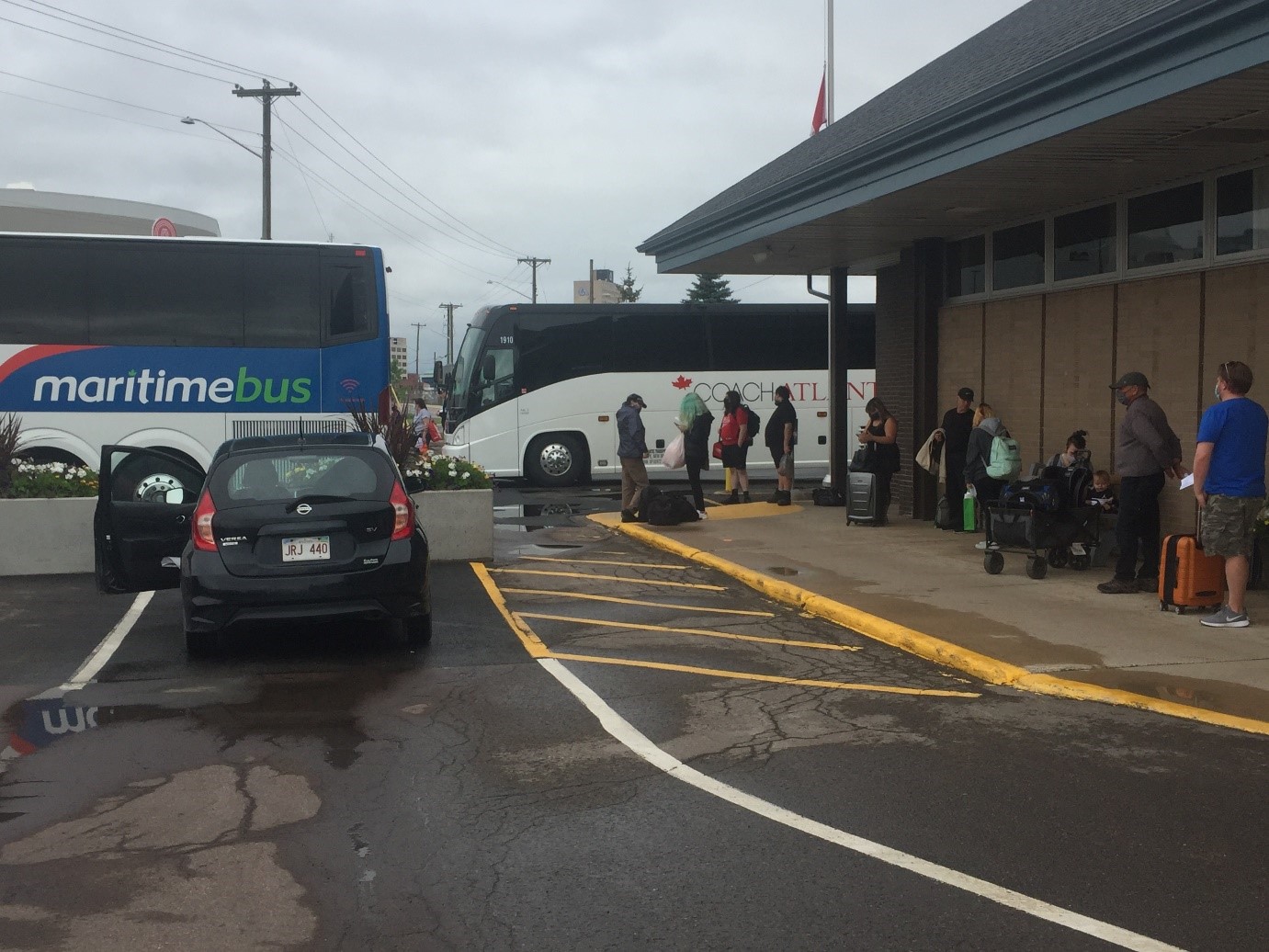
Maritime Bus is maintaining its six-days-a-week modified schedule with extra weekend trips, despite sluggish traffic numbers driven by the uptick in COVID cases. PHOTO – Ted Bartlett

The so-called “circuit-breaker” public health measures to combat COVID-19’s alarming fourth wave were still in effect across much of New Brunswick as the calendar rolled into November. Even though the surge in cases that struck all four Atlantic provinces to varying degrees had shown encouraging signs of retreat, the travel industry’s recovery from the pandemic was clearly inhibited.

Maritime Bus reported a daily average of 270 passengers in October, while maintaining its six-days-per-week reduced operating schedule, with extra weekend departures on Saturday and Sunday. It represented a slight improvement over the same month in 2020, when the buses were running only four days a week, but well short of where the company had hoped it would be at this point. Nevertheless, management feels it would not be wise to reduce service at this time. And, on the bright side, reduced travel has produced an increase in the parcel business, which helps offset the drop in passenger revenue.

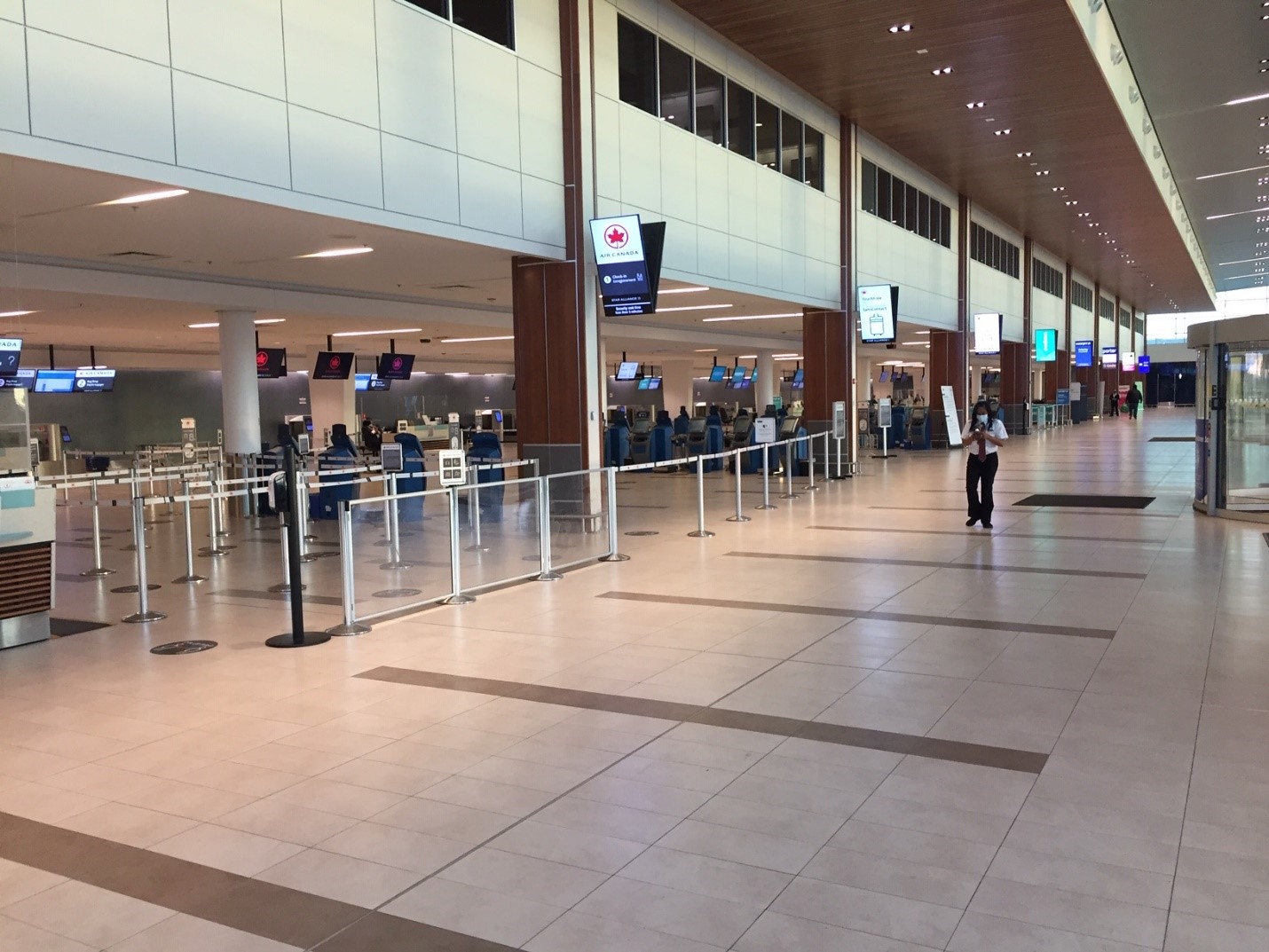
The check-in area of Halifax Stanfield International Airport was largely deserted on the afternoon of November 4.
PHOTO – Ted Bartlett

Two New Brunswick cities are once again without air service to and from Halifax. St. John’s-based PAL Airlines had stepped in to partially fill the void last summer when it became apparent that Air Canada would not be resuming the local services it had provided pre-pandemic. PAL began offering flights five days a week connecting Stanfield International with Fredericton and Saint John. But while passenger loads were encourging during the summer, the airline reached the conclusion that the service wasn’t sustainable through the fall and winter months. The same situation arose with a service between Halifax and Charlottetown that lasted for only two months. A PAL spokesperson says they hope to be back in those market eventually, and meantime plan to continue their services to Ottawa, St. John’s and Deer Lake from Fredericton and Moncton on alternate days. Those routings have been using a larger Q-400 aircraft since last summer. A separate Halifax-Moncton-Wabush flight continues to offer service between YHZ and YQM twice a week.

Both airlines and airport authorities are hoping that the mandatory vaccination requirements for both passengers and crew now in effect will improve the level of public confidence in flying. Halifax Stanfield Airport reports that passenger traffic in August and September 2021 remained at about 40% of pre-pandemic traffic volumes, but officials are optimistic that the vaccine mandate will improve the picture. They are also looking forward to upcoming non-stop international services being added by various airline partners as the “sun season” approaches, when many Canadians enjoy travelling south. New or reinstated non-stop destinations from YHZ in the coming months include Cancun, Orlando, Tampa, Fort Lauderdale, Punta Cana, Varadero, and Montego Bay. Direct Air Canada service to Toronto’s downtown Billy Bishop Airport is also scheduled to resume in December. Still awaiting confirmation are resumption of service in 2022 to several US and overseas destinations.

Meanwhile, St. John’s International was on the list of a limited number of Canadian airports that will be once again permitted to handle cross-border and overseas flights as of November 30. In a CBC interview, YYT’s CEO Peter Avery said no routes have yet been confirmed, but they are hoping that at least some of the direct flights to sun destinations will soon be back. He welcomed the Transport Canada announcement as a good first step toward eventual resumption of overseas flights as well. He noted that while international flights accounted for only about 10% of the airports traffic in pre-pandemic times, they mean a lot to the business community and the province at large.

YYT reported handling a total of 76,046 passengers in September – three times as many as the same month last year but well short of the 134,387 travellers that passed through the terminal pre-pandemic in September of 2019. There were 1107 arrivals and departures during September 2021, versus 707 a year earlier and 2007 in 2019.

Interestingly, both Marine Atlantic and Maritime Bus are exempt from the mandatory vaccination requirements. Spokespersons for both carriers said they are considered essential services. However, Marine Atlantic is continuing to observe extensive public health protocols.

And the Campobello ferry has been granted yet another one-month extension to its operating season. The link to the New Brunswick mainland via Deer Island will continue until the end of November, avoiding the challenges inherent in travelling through the US. The most critical issue for islanders at this point is the requirement to produce proof of a negative COVID test when entering Canada through the border crossing at St. Stephen NB.

PEI TAKES FIRST STEP TOWARD ISLAND-WIDE PUBLIC TRANSIT

Prince Edward Islanders in outlying communities are one step closer to escaping their dependence on private automobiles under a new provincial government initiative that launched in October. This 14-passenger vehicle is one of two serving the eastern portion of the province on two separate routes, each running three round trips daily, Monday through Friday. PHOTO – Cassidy Group

There’s been a game-changing development on the rural transit front in Prince Edward Island. Two new routes linking communities on the eastern end of the island with Charlottetown launched on October 12. The so-called “toonie transit” makes three trips a day Monday through Friday on each route, serving the Montague, Georgetown, Souris, and St. Peter’s areas. Riders pay just $2 each way, and seats can be reserved online.

The service is officially branded Island Transit, and is a division of the Cassidy Group which also operates Maritime Bus, the T3 Transit system in Charlottetown, and a link to Summerside several times a day. The provincially-funded initiative is the first step in what Premier Dennis King says is a commitment by his government to an island-wide public transit system, that will be extended to include communities west of Summerside in early 2022. He calls it an “easy decision to make”, and one that will help reduce the province’s carbon footprint.

Mike Cassidy, founder and CEO of the transportation company, says the response to date has been very encouraging, with the primary users so far being students and commuters. Feedback has been very positive, he says, while recognizing that it will take time for the public to become fully aware of the benefits and the full potential the system offers. With the very affordable fares, he anticipates considerable use by seniors and family groups, as well as for school outings.

The two separate routes each normally use a 14-passenger vehicle, but the company has the flexibility to substitute a larger bus seating 24 people if the online booking system indicates a need on a particular run.

-Ted Bartlett

TRANSIT RIDERSHIP GROWING IN NB’S LARGEST TOWN

Codiac Transpo offered an alternative to commuters while Riverview was reduced to a single crossing to Moncton. The new bridge is now open, but the enhanced transit option proved so popular it will remain in place. PHOTO – City of Moncton

The bedroom community of Riverview NB has a long-standing reputation for being very car-dependent. But that’s finally beginning to show signs of change, and transit ridership is at last showing significant growth. By an interesting twist of fate, it’s largely thanks to a new bridge across the Petitcodiac River.

A once-in-a-lifetime opportunity arose last spring, with the removal of an environmentally-controversial causeway dating from the 1960s. The final completion and commissioning of a $60-million bridge replacement that would fully restore the free flow of the river meant that the town’s 20,000 residents would have to make do with a single river crossing for an estimated six months, beginning in April 2021.

Planning to alleviate anticipated traffic congestion included an enhanced public transit offering that would encourage Riverview commuters to leave their cars at home. And it worked – so much so that the Town Council and Codiac Transpo have agreed to leave it in place, at the current service level pending further evaluation. The new bridge opened on budget and ahead of schedule in September, but bus ridership remained high. Codiac Transpo’s director of operations Alex Grncarovski says the numbers are still about double what they were before the causeway closed, describing the outcome so far as “fabulous”, with the qualifier that it’s still too early to draw final conclusions. It’s likely that ridership will improve still further once office employees complete the transition back to their downtown work locations.

Director of operations Alex Grncorovski says for a small transit agency Codiac Transpo is doing very well indeed.

Meanwhile, across the system, improved technology will soon offer greatly improved monitoring of ridership. New fareboxes combined with back-office software are expected to yield a wealth of data for future planning purposes. Mr. Grncarovski noted that Moncton City Council recently approved additional service hours, effective November 7, that brings a number of routes another step closer to what they were before the pandemic struck.

“We’d love to be back to where we were pre-covid,” he says, adding that it’s hoped there will be evening and Sunday service extensions in place by February. “Of course, we can’t please all the people all the time, but for a small transit agency we’re doing very well indeed.”

Having worked in a supervisory role at the Toronto Transit Commission before moving to Moncton eight years ago, he was quite surprised on arrival that Codiac Transpo offered wifi on all its buses – something the TTC still doesn’t have. And Codiac users can now use their smartphones to find out exactly where their bus is. Another big-city innovation coming soon is an automatic annunciator, which will give an audio and visual message to passengers to alert them to their stop.

A call for government action on urban transit in these challenging times

By Sheldon Phaneuf

Governments must intervene before it is too late

Urban transit has not escaped the devastating effects of the global pandemic. Service levels have been cut to public transit systems throughout Atlantic Canada. Although there are some systems that have restored service, many remain operating at significantly reduced levels.

Fredericton 50-60%

Moncton 70%

Saint John 70%

St. John’s 65-70%

Senior transit staff and municipal officials have been consistent with their messaging. “Service levels cannot be restored until ridership increases”. How can ridership increase if service is restricted?

There is a pivotal point at which the service cuts that were put in place in response to a temporary decrease in ridership begin to drive rider behaviour. Experts warn that public transit is on the verge of suffering long term consequences and refers to the phenomenon as a “death spiral”.

Ridership decreases. Revenues drop. Service is cut. Ridership further decreases because of a reduced service schedule…and the cycle continues.

If service cuts weren`t enough, the death spiral phenomenon is being further accelerated by passenger capacity restrictions, imposed by provincial health authorities in response to regional COVID-19 outbreaks. These restrictions are necessary to safeguard the health of passengers and transit workers, but the impact on transit systems already crippled by service cuts is overwhelming.

A small change in perspective leads to a significant change in point of view

We can no longer accept the argument from provincial and federal levels of government that urban transit is a “municipal problem”. The fate of public transit cannot rest solely on the shoulders of the cities in which they operate. That does not mean municipal level governments can stand by and watch their transit systems fade into obscurity. The myopic view of public transit is rooted in the ill-informed assumptions of our city councillors, even those who call themselves “transit friendly”.

As long as public transit continues to be viewed as a reviled but necessary line item on municipal budgets, nothing will change. We need a fundamental shift away from the belief that public transit is a drain on municipal finances. Our elected officials must first come to terms with the fact that public transit will never pay for itself. Then they need to recognize that a full-service public transit system is an integral part of the municipal service infrastructure of any successful city. Public transit is an essential service.

Finally, they should consider the fact that public transit is one of the very few municipal services that “self-subsidize”. Public transit offsets its cost by generating revenue for city coffers. Imagine if other municipal services (road maintenance, waste collection, administrative support services, etc.) brought in $40 for every $100 they cost the city to operate, as public transit does. (Source: CUTA Revenue Cost Ratio Data 2018). Ironically, although public transit is one of the few city services to generate revenue, its often the first to suffer service cuts.

Public transit drives regional economic and population growth strategies

In the fall of 2020, the province of New Brunswick declined to participate in a federal relief program for municipal transit after misunderstanding who it was for and what it covered. Provinces were initially supposed to match federal dollars, but loopholes in the program resulted in provincial governments not having to put up any matching dollars. The New Brunswick government decided to fund municipal transit losses under the Federal Safe Restart program, but these funds were exclusively for pandemic related losses and no money was offered to help restore public transit service cuts.

The Nova Scotia provincial government accepted $16 million dollars under the public transit aid program. Coincidently, Halifax Transit returned to 100% full service in September 2020.

Our provincial leaders must pull their heads out of the sand and recognize the important role that public transit plays in regional economic and population growth. Population growth in Atlantic Canada is under threat from an aging population, low birth rates, high rates of out migration and low rates of interprovincial migration. In 2017, the federal government launched the Atlantic Immigration Pilot (AIP) to promote immigration in Atlantic Canada. Initial results are promising. In 2019, Atlantic Canada broke previous immigration records and welcomed 18,000 newcomers. These newcomers are professionals, entrepreneurs, working class and students and are typically drawn to the larger urban centres to which they are accustomed and that provide services like an efficient and affordable public transit system.

Public transit requires operational funding from all levels of government

In February 2021, the federal government announced almost $15 billion for public transit over the next eight years. This funding announcement exposes a crucial lack of understanding for what public transit needs to survive. The current federal and provincial investment strategy falls short. It fails to address the immediate and ongoing need for operational funding. Elected officials at all levels of government need to adjust their focus and consider the “return on investment” achieved through operational funding of public transit. 

Funding of public transit plays a vital role in supporting the social welfare network and provides mobility to our seniors, our low-income workers, and our students. Subsidizing efficient and affordable public transit systems will help drive a national strategy to reduce greenhouse gas emissions.

Ongoing operational investment in public transit fuels regional economic and population growth. When our elected officials look through this lens, they will see what advocates of public transit see…and finally begin to understand the social, environmental, and economic benefits of investing in urban transit.

Sheldon Phaneuf is a bus operator at Codiac Transpo in Moncton, and a member of ATU Local 1290