Discontinuance approved for Cape Breton rail line …but is it really the end?

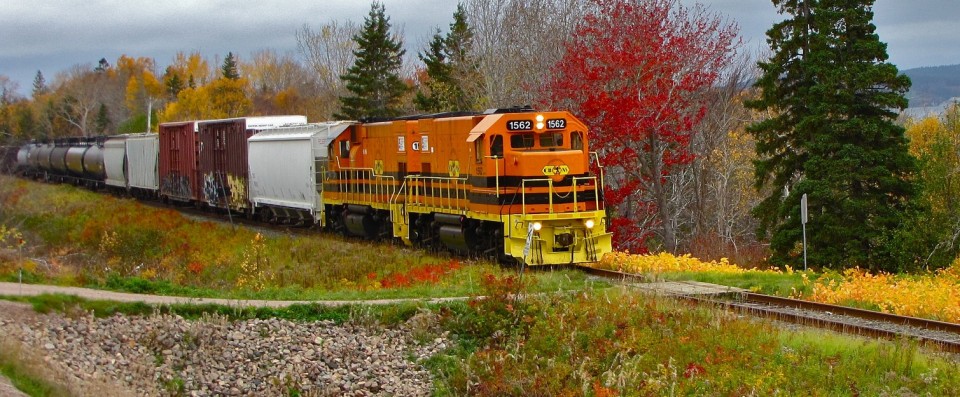
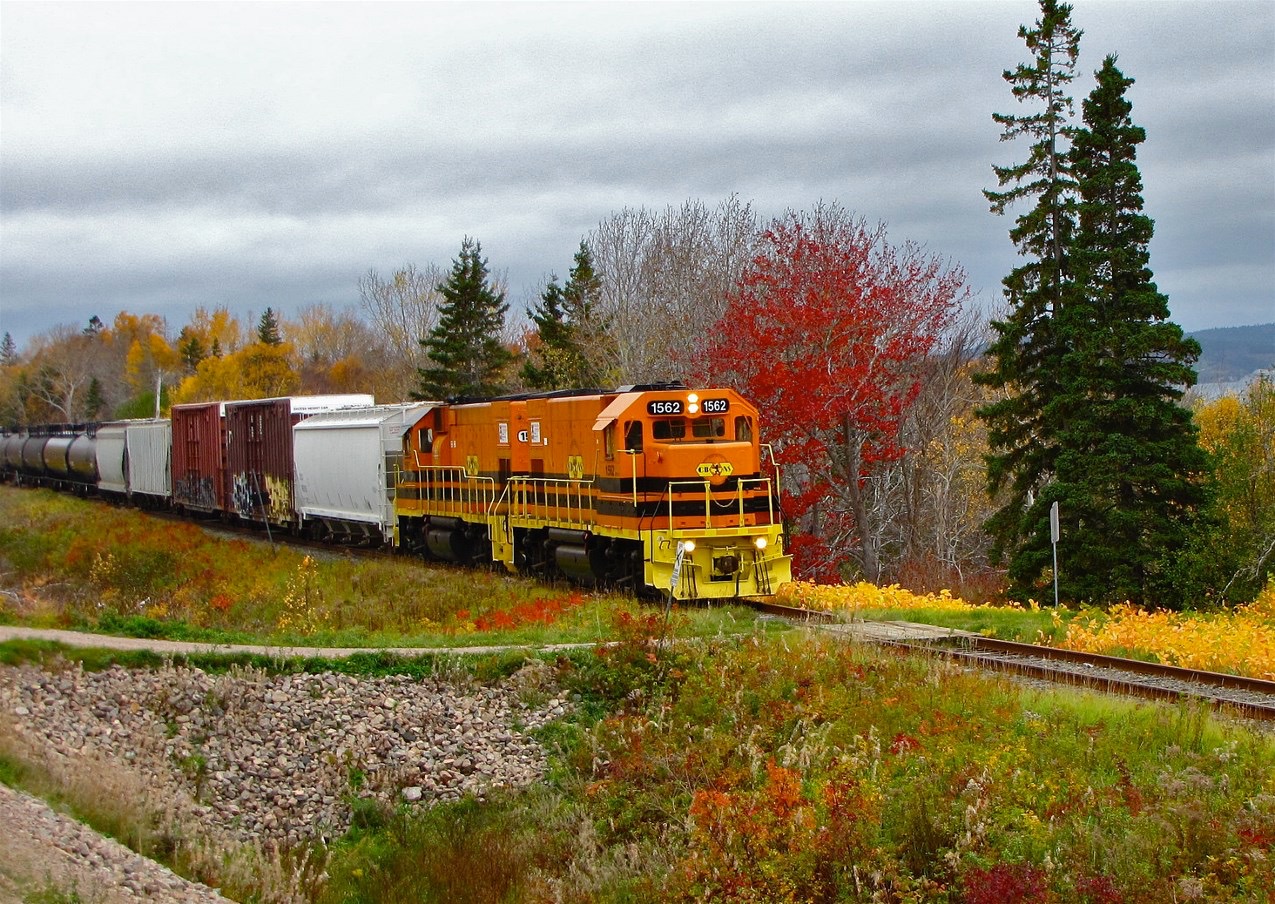
Freight train led by two orange and yellow locomotives in centre of image, surrounded by fall foliage under an overcast sky.
Amid fall foliage near Shunacadie NS on 5 November 2014, a 16-car CB&CNS train rolls toward Sydney with two units resplendent in Genesee and Wyoming’s colourful orange livery on the point. Pretty as this picture may be, the reality for this endangered line is grim indeed. Yet there may be a glimmer of hope on the horizon.

A ruling has been issued by Nova Scotia’s Utilities and Review Board (UARB) on the application by the Cape Breton and Central Nova Scotia Railway (CBCNS) to discontinue service between St. Peter’s Junction near Point Tupper and Sydney.  But there’s a great deal of uncertainty as to what it means.  Meanwhile, a group of users, several business organizations, the provincial government, and the Cape Breton Regional Municipality are not prepared to pronounce the rail line dead at this point.

The railway’s owners – US-based Genesee and Wyoming Inc. – have made it clear that they are finished.  Company representatives bluntly told the UARB hearing on December 8 and 9 that no trains would operate after December 31, 1014, under any circumstances, and the line has now effectively been shut down. But the board’s ruling on January 15 set a different date for the end of service – October 1, 2015.  Until then, the UARB says, “CBCNS must deliver goods by rail if that service is required by a shipper and the shipper is prepared to pay a reasonable rate for that service…”

Under the legislation governing provincial shortlines, the UARB cannot order a company to continue an uneconomic operation, but does have the authority to set the timeframe for discontinuance of service.  Furthermore, under amendments to the Railways Act that received speedy passage with all-party support in the Legislative Assembly last fall, the actual physical abandonment of a line now falls under the jurisdiction of the transportation minister – not the UARB.   In order to remove the tracks, CBCNS will have to negotiate with the Honourable Geoff MacLellan – a Cape Bretoner who is on record as supporting the retention of rail service.  And, the minister would appear to have a lot of public support on the island. Continue reading “Discontinuance approved for Cape Breton rail line …but is it really the end?”

The UARB hearing – an eyewitness account

– by Tim Hayman

(Editor’s Note: Don MacLeod, Ashley Morton and Tim Hayman represented TAA at the Sydney UARB hearing in December.  Ashley Morton delivered the opening statement, but was unable to be present for closing arguments due to other commitments.)

The hearing got off to an interesting start, with the legal counsel for the CBNS (Michel Huart) raising concerns about potential bias on the part of the Chairman of the Board (Peter Gurnham), as Mr. Gurnham had been legal counsel for NSPI during the previous abandonment hearing in 2002. After a short period of deliberation, the board decided that there is no bias issue, as Mr. Gurnham had taken an appropriate period of abstention (three years) following his original appointment to the board.

CBRM was first to present, and made their case that the hearing should be adjourned until CN is at the table. They argued that the proposed discontinuance plan is not adequate if CN is not involved, due to “the letter” (I’ll just call it that, as we all know what that means). The Chair questioned whether CN’s obligation would only kick in if the CBNS discontinuance actually goes through, rather than at an earlier stage. CBNS responded simply: “we’re not CN, and we’re not the province”.

The board determines that the meeting will continue, as the Chair notes that UARB has no jurisdiction over either the province or CN, but suggests that it will be acceptable for participants to refer to that issue throughout their arguments.

CBNS began the formal process, by calling two witnesses for examination by Mr. Huart – these are Josée Danis, AVP of Corporate and Industrial Development for Genesee and Wyoming Canada, and Gareth Martin, in charge of sales and marketing for the CBNS. It is noted that Ms. Danis was assigned specifically to oversee the discontinuance and abandonment of the Sydney Sub. She has past experience (10 years) at CN, and seems very well versed in this kind of setting.

Continue reading “The UARB hearing – an eyewitness account”

TAA’s Opening statement to the UARB on Dec 8, 2015

Here is the full text of TAA’s opening statement, as presented at the UARB hearing in Sydney on December 8, 2014, by Ashley Morton.

Transport Action Atlantic is a non-profit, charitable organization that works to promote and support all forms of public transport and sustainable transportation throughout Atlantic Canada.  We are particularly partial to the rail mode as environmentally responsible, socially beneficial, safe, and efficient. And our membership believes that there must be rail to Sydney.

We understand that the only topic formally before the Board today is simply the question of notice period. However, it is the position of Transport Action Atlantic that it is precisely because this service is so important that the notice period must be as long as possible. A longer notice period allows greater opportunity for another solution to be found, and offers a greater likelihood that that solution, when implemented, will be fully-thought-out and ready to be successful, rather than something “patched together” under the urgency of an impending deadline. Therefore, we must discuss why this rail line must be maintained and enhanced – not discontinued and then abandoned.

First, we point to the letter the Cape Breton Regional Municipality has raised, regarding the commitment made by CN in 1993 to ensure continuing service on this railway, in the event that Cape Breton & Central Nova Scotia ever commenced abandonment proceedings. This commitment was referenced by the National Rail Transportation Board in their ruling allowing the transfer.

CN, as a Crown corporation at the time, clearly spoke with the weight of the federal government behind them. Of course CN is no longer a Crown corporation. But if the privatized CN has not inherited the requirements of that commitment, it clearly must be the federal government that now bears that obligation. However, it is illogical and silly to think that the commitment simply vanished into thin air when the Government of Canada chose to privatize CN. Someone is obliged to fulfill it. Continue reading “TAA’s Opening statement to the UARB on Dec 8, 2015”