VIA tightens Ocean Schedule

There has been a slight improvement in the Ocean schedule, with the issue of a new timetable shortening the overall time between Montreal and Halifax by one hour.  Effective February 18, train 15 departs from Halifax at noon instead of 1100, and arrival of #14 will be an hour earlier at 1735.  Arrival and departure times at Montreal remain unchanged.

The schedule tightening is partially due to track improvements completed in 2014, but the dwell time built into the schedule to accommodate switching at Matapédia for the now-dormant Gaspé service has also been eliminated.  One permanent slow order that hasn’t changed is on the Bathurst to Miramichi segment, which still requires an hour and 41 minutes.  Sixty years ago the steam-powered Ocean Limited covered the 44 miles in well under an hour.

Last fall, Steve Del Bosco, chief advisor to VIA’s CEO, told Transport Action Atlantic that discussions were ongoing with CN regarding track speed.  (Mr. Del Bosco retired at the end of January after 36 years of service, having been with the company since its earliest days.)  Unconfirmed reports suggest that the new timetable is but an interim step, and that further improvements may be pending.

Fifty years ago the Ocean ran between Moncton and Campbellton in four hours flat, a time that changed little over the next four decades.  But the effects of deferred maintenance eventually came into play, as more and more slow orders were imposed, adding over two hours to the scheduled time by 2014.  The new schedule, while an improvement, still requires more than 5½ hours for the Moncton-Campbellton run.

The schedule change also restores some lost bus connections at Moncton and Truro for passengers to and from PEI, Cape Breton and the Newfoundland ferry.  While all are now theoretically possible assuming on-time arrivals, the situation at Truro is complicated by the unfortunate fact that Maritime Bus no longer calls at the VIA station there.

VIA cautiously optimistic over holiday results

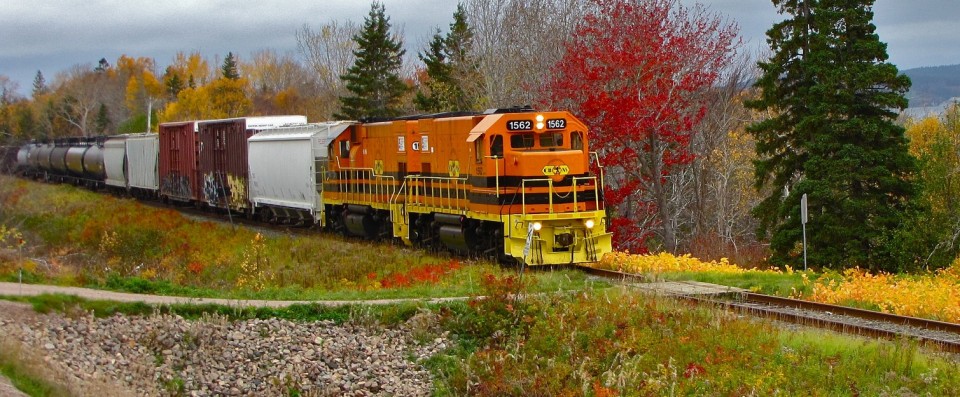
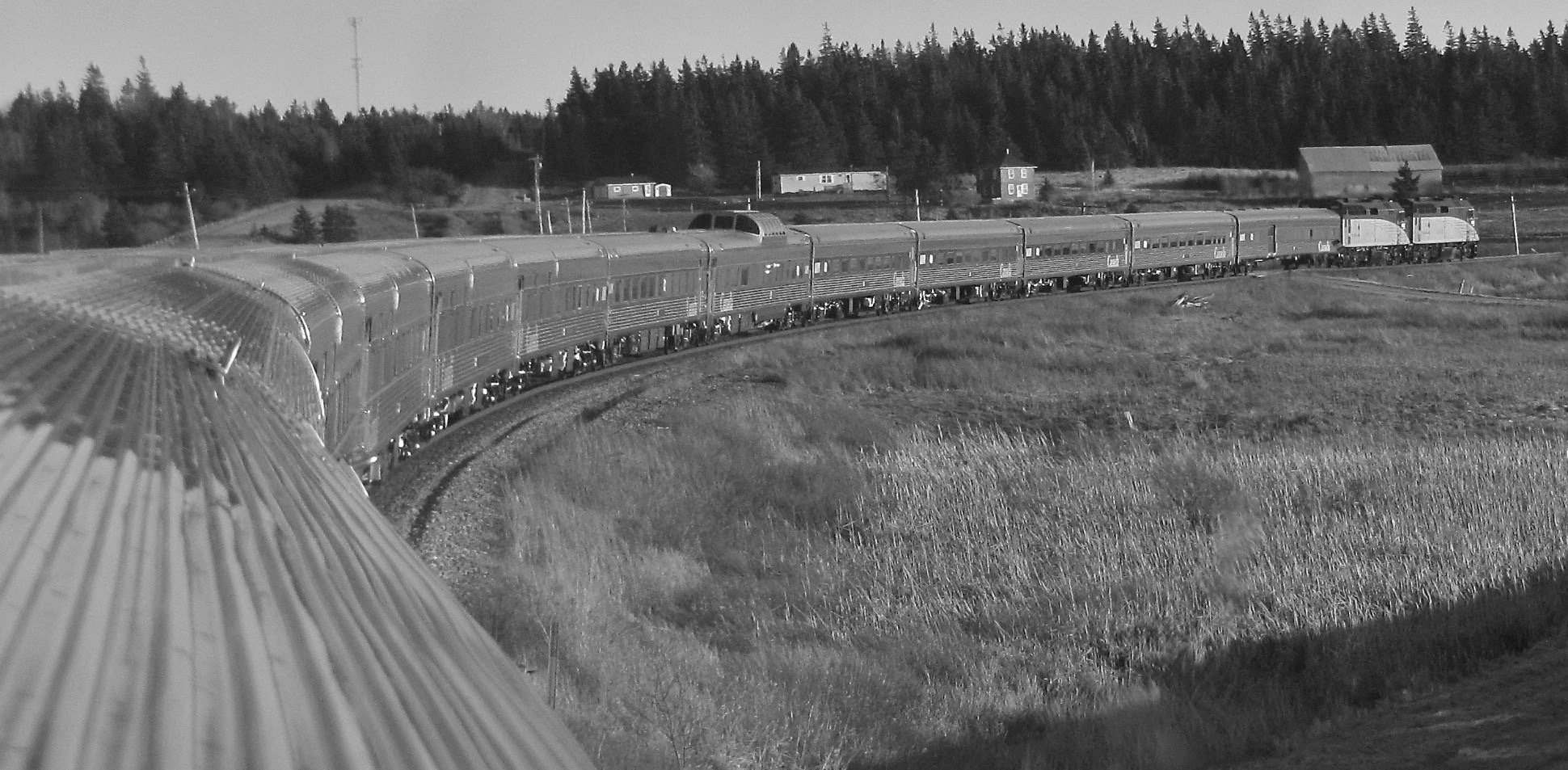
A train curves from the lower left of the photo to the upper right.
An all-Budd stainless steel extra holiday Ocean rolls east across the Tantramar Marsh near Sackville NB on December 30.
PHOTO: Tim Hayman

The new management team at VIA Rail is evaluating the results of initiatives taken for the 2014-2015 Christmas and New Year season.  In November the company announced three additional departures in each direction over the three-week peak travel period, to augment the usual tri-weekly schedule that has been in place since October 2012.  And, for the first time in many years, VIA launched a newspaper and radio advertising campaign to promote the additional service.

The extra trains operated eastbound on December 18th,  22nd, and 29th, and westbound on December 20th and 27th, as well as January 3rd.  The additional consists were all Budd stainless steel cars, which offered the lowest cost per passenger mile and flexibility to add extra coaches or sleepers if needed.

Martin Landry, VIA’s chief commercial officer, was cautiously optimistic about the outcome, acknowledging that the decision to add the extra holiday trains wasn’t made until November, and – despite the advertising campaign – really came too late for maximum impact.  Nevertheless, total traffic over the holiday period was up 6 percent from the previous year.

“We knew we were late to the game, but we wanted to do it anyway,” he said, viewing the experience as a learning opportunity in finding solutions to dealing with what he calls the “super peaks” in traffic. “I’m not going to commit to anything right now, but I don’t think this is a one-off. It wasn’t a home run, but I’m not disappointed by the outcome…not as strong as I might have liked, but there were lessons learned.”  Points to consider in retrospect include timing as well as the type of accommodation offered, given that the demand for economy seats was stronger than for sleeper space – which could be explained in part by the fact that only “sleeper-plus” class was offered on the extra trains.  He also acknowledges that the student market segment is very important to VIA.

Woman with dark hair, in a winter dress coat, standing next to a VIA Rail traincar.
Susan Williams is VIA’s new GM for eastern Canada. She will be the featured guest speaker at TAA’s annual general meeting in Moncton on April 25.

Mr. Landry is also very enthusiastic about the recent decision to appoint a senior executive with responsibility for Atlantic Canada.  Susan Williams, originally from Nova Scotia, will be based in Halifax and will be paying very close attention to the market in this region.  Her mandate, he says, is “don’t assume anything,” and includes examining all possible options, such as how best to provide inter-city service within the Maritimes, and through service to Toronto.

In a February 3 news release, VIA said “Ms. Williams will be working to bring VIA Rail’s service offering in line with this part of the country’s needs and demands. This is one of the first steps of a larger strategy to better serve Eastern Canada.”

The right move

Commentary by Donald R. MacLeod

The owners of the Truro to Sydney rail line (Genesee and Wyoming) have been given permission by the Nova Scotia UARB to discontinue service on that section of the line between Point Tupper and Sydney later this year. The owners claim that there is not sufficient traffic volume over that subdivision to justify continued train operations, even with a Nova Scotia government subsidy to make it at least break even. The line between Point Tupper, with its heavy industry, and Truro operates in the black, and overall the whole between Truro and Sydney is profitable. Why would the owners want to abandon this section with prospects of potential future traffic good, infrastructure funds available for upgrades, and the Province’s offer to continue the subsidy?

The answer could be that by closing the line and liquidating the assets including the rails, other infrastructure and long stretches of property fronting on the Bras d’Or lake would bring immediate and handsome return for Genesee and Wyoming – much more than continuing operating the trains at break-even.

The Nova Scotia Railways Act was passed back in the 1990’s when several secondary lines in the Province were sold by the major railroads to short line operators, bringing them under provincial jurisdiction. Back in the 1990’s there was little thought given that when railroads close, rails removed, the buildings torn down and the yards vacated there is left what could be described as an environmental quagmire. The only sections in the act that dealt with abandonment of a rail line was that the Province would have the right of first refusal to the assets – which when looking back appears to have been an oversight.

The Province recently had to remove several bridges on an abandoned rail line in the Annapolis Valley at very high cost, and now potentially faces the same situation in Cape Breton where the environmental clean-up could reach many million of dollars. The Province is now in the process of amending the act and regulations so that the owner will be responsible to leave the property in a fit condition as part of the abandonment process. This is a good move for two reasons.

First: faced with the high clean-up costs on leaving, the railroad owners should be more financially accommodating in arranging a takeover by the province or another potential operator. As one person said to me recently, it is possible that the price could be as low as a token dollar as the owners abandon Cape Breton.

Second: If the Province takes over the line across Cape Breton as salvage, at least the proceeds of the salvage (rails, property) would offset the clean up cost which could balance out at a small gain or loss. If the line cannot be saved, the government would have control of end land use for purposes of hiking trails, commercial use or recreational parks, and it would be cleaned up properly.

All considered, the legislative action is the right move for the Province to take at this time, and I believe the amendments to the Railways Act will ultimately save the line across Cape Breton Island.  The Orangedale whistle may indeed once again be heard.