
(Editor’s note: Between the two days of UARB hearings, a community meeting to discuss the future of rail service was held on Monday evening, December 8, at the Civic Centre in Sydney, chaired by Mayor Cecil Clarke of the Cape Breton Regional Municipality. TAA’s Don MacLeod and Tim Hayman were there. Here is Tim’s first-person report.)
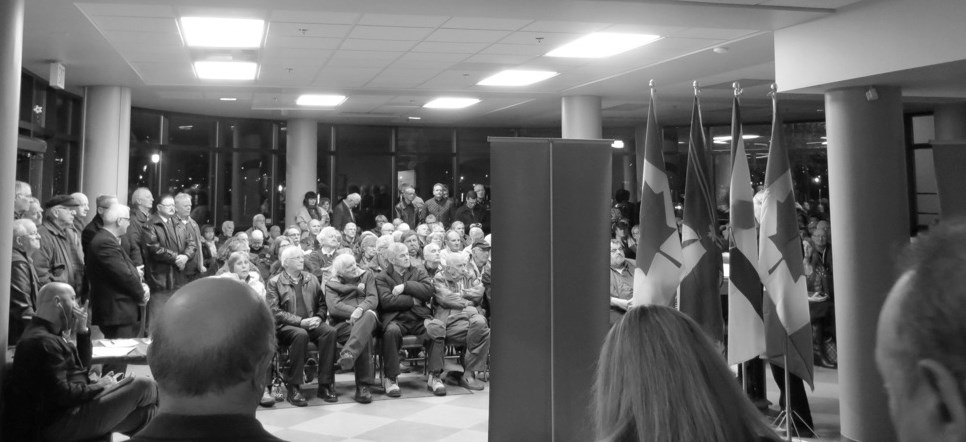
We arrived shortly before 6pm, and the room was already packed. The numbers kept growing up to the start, and it was standing room only (and not much of that!). The crowd seemed to be fairly diverse as well. A sign-up sheet was at the door and attendees were encouraged to sign their names and contact information.
Keith McDonald gave a summary of the UARB hearing so far, and passed it over to Ian McNeil, who made some further comments about the hearing.
Dr. David Rae (Dean of Business at Cape Breton University) then took the floor and gave an engaging and interesting presentation on their plans, emphasizing the need for community support. He wants to arrange the transfer of the entire line, but the issue then is how to gain ownership and get funding for infrastructure. There is a lot of desire to get G&W out of the picture, and bring in a new operator. He suggests some sort of model that would encourage business investment, perhaps similar to the Business Cape Breton model.
There is no illusion that it’s going to be a difficult, but there is no other choice.
The stage was then passed over to Charlie Palmer, who even at 90+ years of age was able to give an engaging and inspiring speech, emphasizing how effective transportation is the key to success. He did occasionally slip into referring to CBNS as CN (no doubt from the many long years of fighting with CN on the same issues!), but he was overall quite coherent and made his point well. He was very well received by the crowd as well.
The floor was then opened to questions from the crowd, some of which were interesting, and some of which were a little off the wall – one citizen seemed to be terrified that if another world war breaks out, we’ll need rail access to the port of Sydney for the war effort (I can’t say I think that’s our best line of attack!). One thing was clear: of the people who spoke, many are passionate about the issue, and a lot of people are very angry with the prospect of losing the line. This seems to be building on many many years of similar losses of service.
There was actually quite a lot of focus on passenger rail, interestingly enough. Some folks wanted a return of the railliners, and several brought up possibility of a tourist train along the Bras d’Or lakes. Dr. Rae mentioned this as well, specifically comparing it to success stories in the UK. This may not be the place to start, but it’s no doubt another option to make the line viable and well used.
One of the exciting things about the meeting was the attendance of NS Transportation Minister Geoff MacLellan, who expressed his firm support for these initiatives. He was very vague in what exactly the Province might do, but he did state clearly that the Province is going to do whatever they can. Bill 65 (the amended Railway Act) is leading to new regulations that should be ready by June, and will ensure that G&W is not able to walk away and leave the cleanup bill to the Province, assuming we get that far along in the process. Minister MacLellan also expressed optimism that there are other possible operators in Canada, the US or elsewhere, who may be able to assume the operation. But the core message was clear: we need to build a business case to keep the rail line there.
CBRM Mayor Clarke then gave a condensed version of his prepared remarks for the UARB hearing. He stressed that while G&W is losing money now, the number of businesses that lose out without the rail line vastly outweigh that. He proposes that a rail operation set up more like the NSPI (regulated utility) model could be successful. He also stresses that G&W has not honoured the UARB process (by effective early discontinuance). His final point is to note that the CN/NS Letter was a deliberate part of the legal process at the time, and that it wasn’t just “some letter”; the core purpose was to ensure the shortline operator would not face undue competition from CN’s intermodal business, by imposing a financial consequence on CN if the shortline failed.
The mayor also mentioned that there are very real major developments in the works, but that they are protected by non-disclosure agreements at this time, which is why G&W has not been able to get details (which they referred to in the hearing as simply “not hearing back” from CBRM).


