Atlantic Transport News – June 2021

Welcome to the June edition of Atlantic Transport News!

Here’s a look at what you’ll find in this edition:

DECISION MAKERS NEED PASSION AND COMMITMENT SAYS MOTORCOACH INDUSTRY LEADER

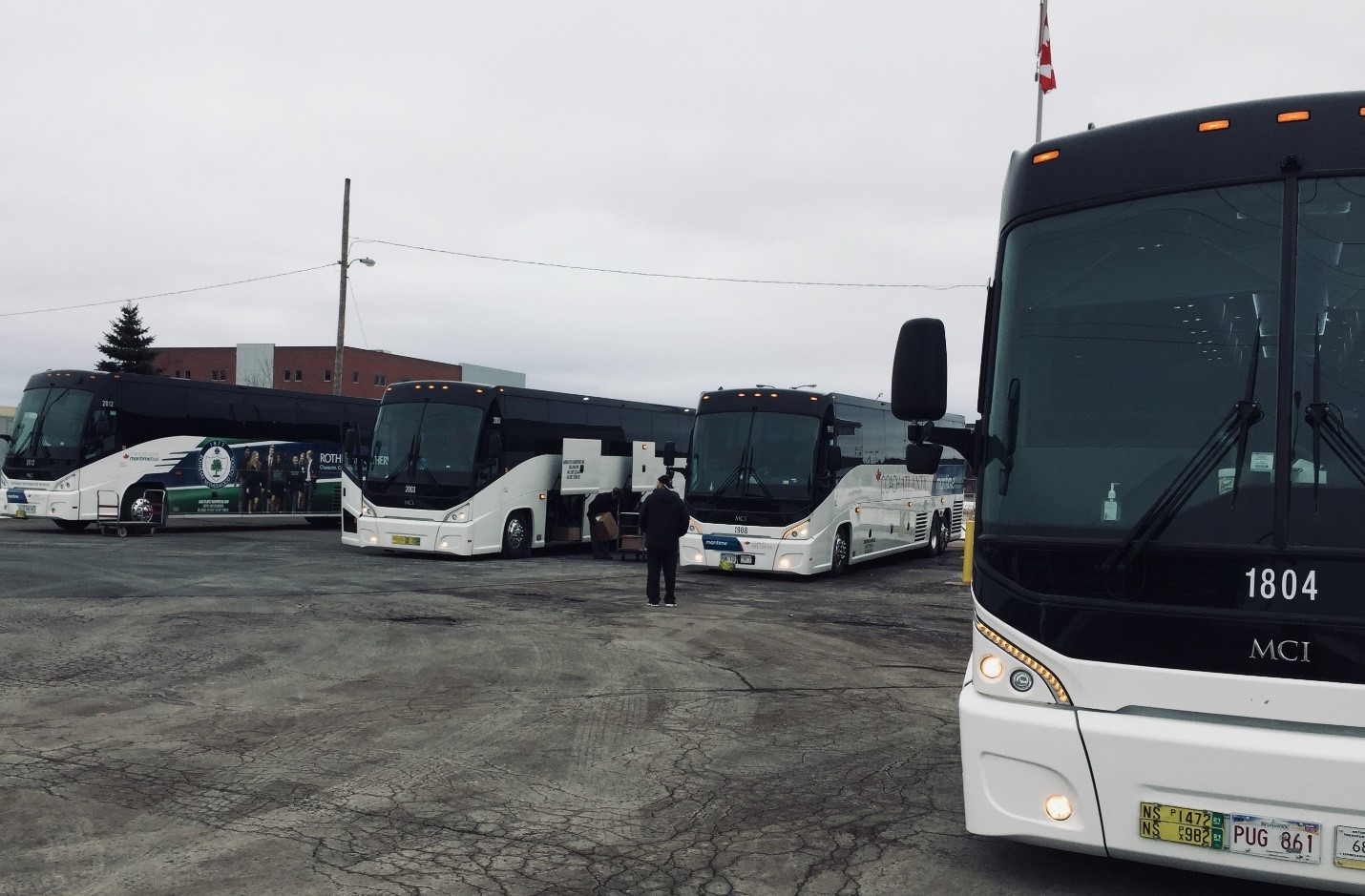
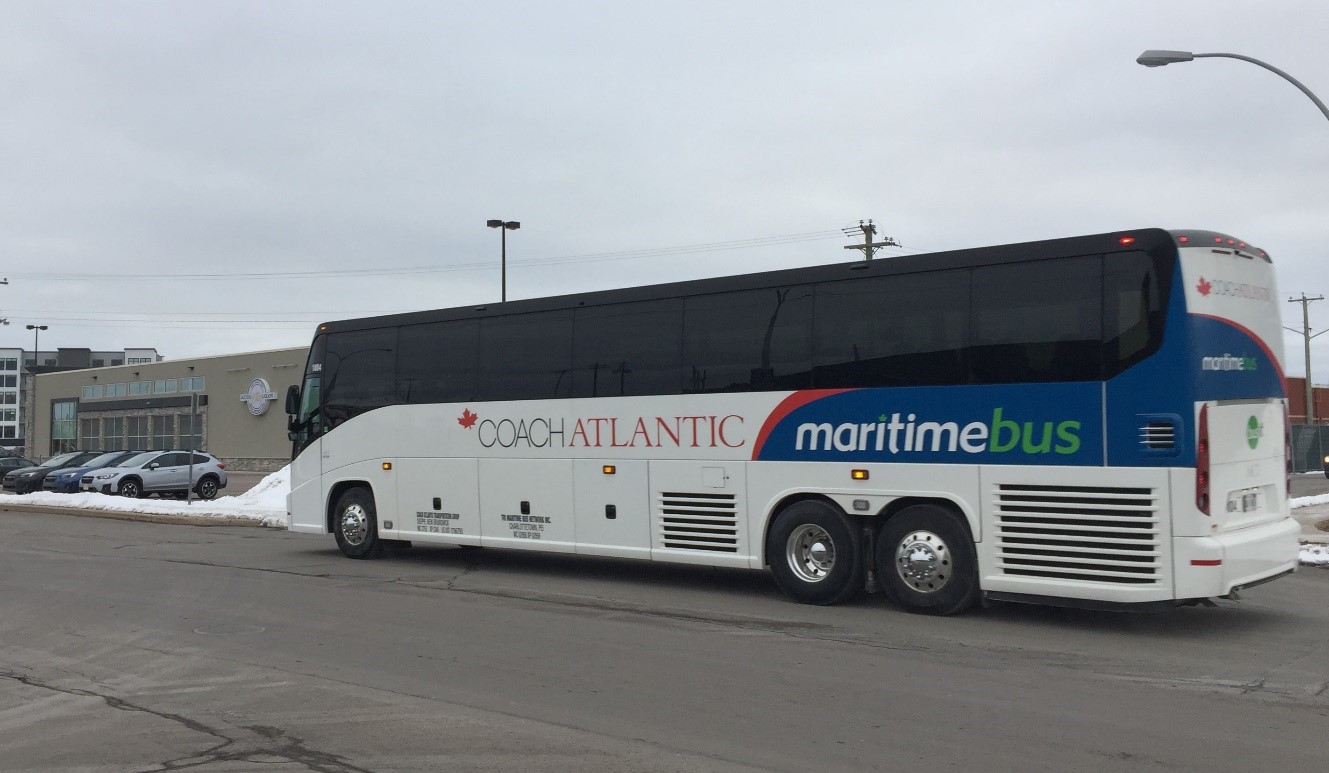
Maritime Bus owner Mike Cassidy (second from left) wants to hand over a successful motorcoach business to his sons Ryan, Matthew and Stephen – but he fears for the future of the industry because governments aren’t taking the public need seriously.  PHOTO – Maritime Bus

There’s an evident lack of passion and commitment about the public transportation needs of Canadians among key government decision makers, according to the Prince Edward Island entrepreneur who rescued line-haul motorcoach service in the Maritimes from the brink of oblivion nine years ago. Mike Cassidy was guest speaker at the virtual annual general meeting of Transport Action Canada held on May 27. 

In an hour-long “fireside chat” with TAC members, the Maritime Bus owner expressed his frustration with all the politics inherent in the struggle to re-establish a coast-to-coast network of motorcoach operators to transport both people and parcels between communities that are badly underserved by public transportation. Mr. Cassidy is one of several independent bus company operators from across the country that are working together in an effort to jointly assemble a coherent national system from the wreckage left in the wake of Greyhound’s abandonment of its Canadian operations.

Although the technology exists to establish an integrated system for reservations and package interlining, the support of governments – especially the Government of Canada – is essential to make it happen, he insists. And there’s little indication of any appetite or sense of urgency at the top. While some individual politicians, including some Liberal MPs, have been supportive, there’s no passion for public transportation among those with the authority to make decisions and who ultimately control the purse-strings.

There is indication that the federal government’s new Rural Transit Fund is only available for non-profit organizations, which could be another nail in the coffin for companies like Maritime Bus. Senior officials are evidently not prepared to acknowledge that commercial motorcoach operators are in dire straits and in need of a helping hand because of the pandemic. His company was modestly profitable prior to 2020, Mr. Cassidy says, and he’s built his business on passion and a commitment to the industry. He’s proud of the fact that he was able to succeed where big corporations like the multi-national transportation giant Keolis could not. And during the COVID crisis buses have continued to carry people to their destinations when trains and flights have been suspended. Now should have been the time to invest in motorcoach, but it is not happening. Even Greyhound’s demise has not been enough to ignite the passion. 

“I just wish the Canadian government believed in Canadian bus companies,” he concluded, adding that a modest investment of $30 million over ten years would be sufficient to restart and maintain the coast-to-coast motorcoach system.

-Ted Bartlett

NL MOTORCOACH OPERATOR MAY BE FORCED TO SHUT DOWN

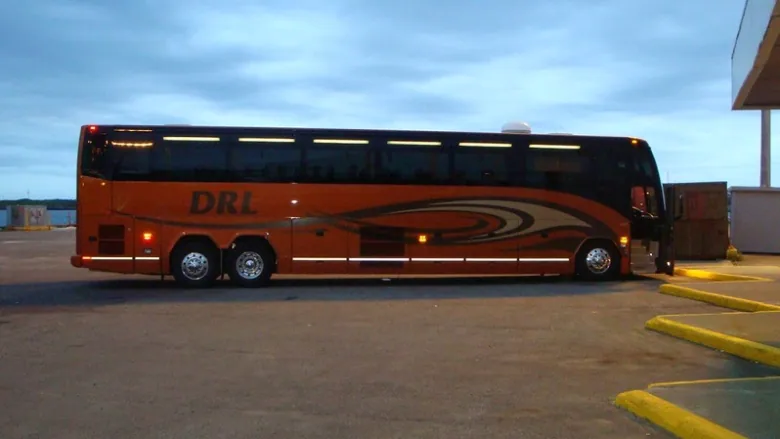
Despite several interruptions during COVID-19 peaks, DRL Coachlines has for the most part maintained its daily service across Newfoundland. But ridership is a fraction of pre-pandemic levels, and mounting losses may soon force the company to shut down. PHOTO – Canadian Public Transit Discussion Board

The owner and general manager of the motorcoach company that operates a 900 km daily service on the Trans-Canada Highway across Newfoundland’s cross-island bus line says ridership has hit rock bottom because of COVID-19. Without some form of financial relief from government, Jason Roberts says the mounting losses may force his operation to shut down as early as this month.

“It’s very, very disheartening,” he told CBC News, adding that he’s been asking both the federal and provincial governments for months to extend a helping hand that would enable his company to weather the pandemic storm – but to no avail.

There’s plenty of precedent for taxpayer assistance to for-profit companies during the pandemic, Mr. Roberts said, pointing to massive federal bailouts for air carriers and interim funding offered for bus operations by provincial governments in the Maritimes.

“Everyone’s trying to stay put as much they can so, I don’t expect them to travel, but the ones who got to travel, they still need a means to go,” he said, adding that if he has to suspend DRL’s daily services, it might not make sense to start them up again a few months down the line. “It’s not going to be easy to pick it up and put it back on the road, and make it something that’s going to be very flourishing again, so it’s very important for us to keep going,” he said. DRL acquired the trans-island bus service from newly-privatized Canadian National in 1997. The so-called “Roadcruiser Service” had replaced the CN passenger train in 1969, and federal government responsibility to ensure continuing service at fares consistent with passenger rail elsewhere in Canada was acknowledged in the 1988 federal-provincial Memorandum of Understanding that provided for final abandonment of the Newfoundland Railway.

LITTLE GOOD NEWS FOR REGION AT VIA PUBLIC MEETING

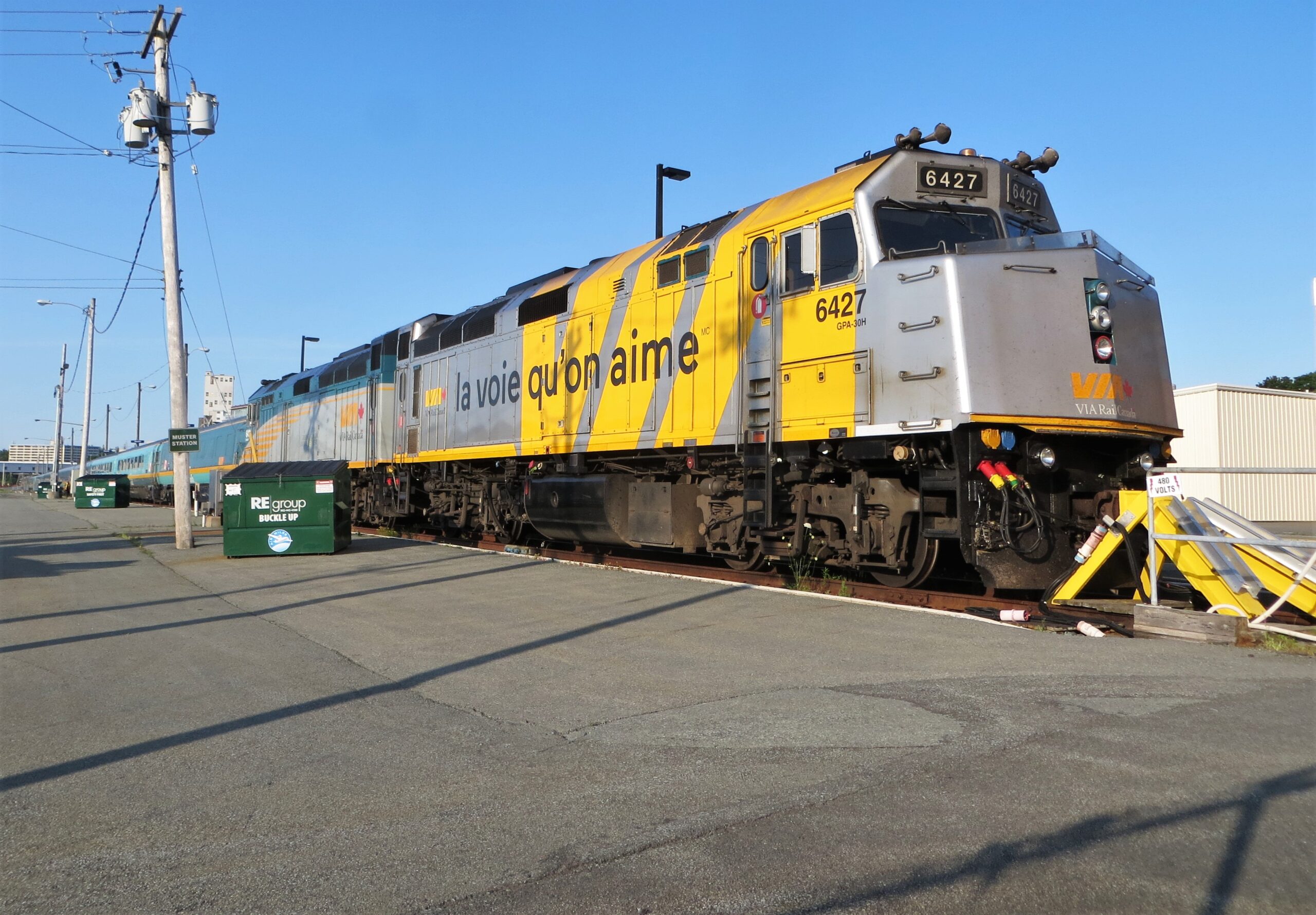
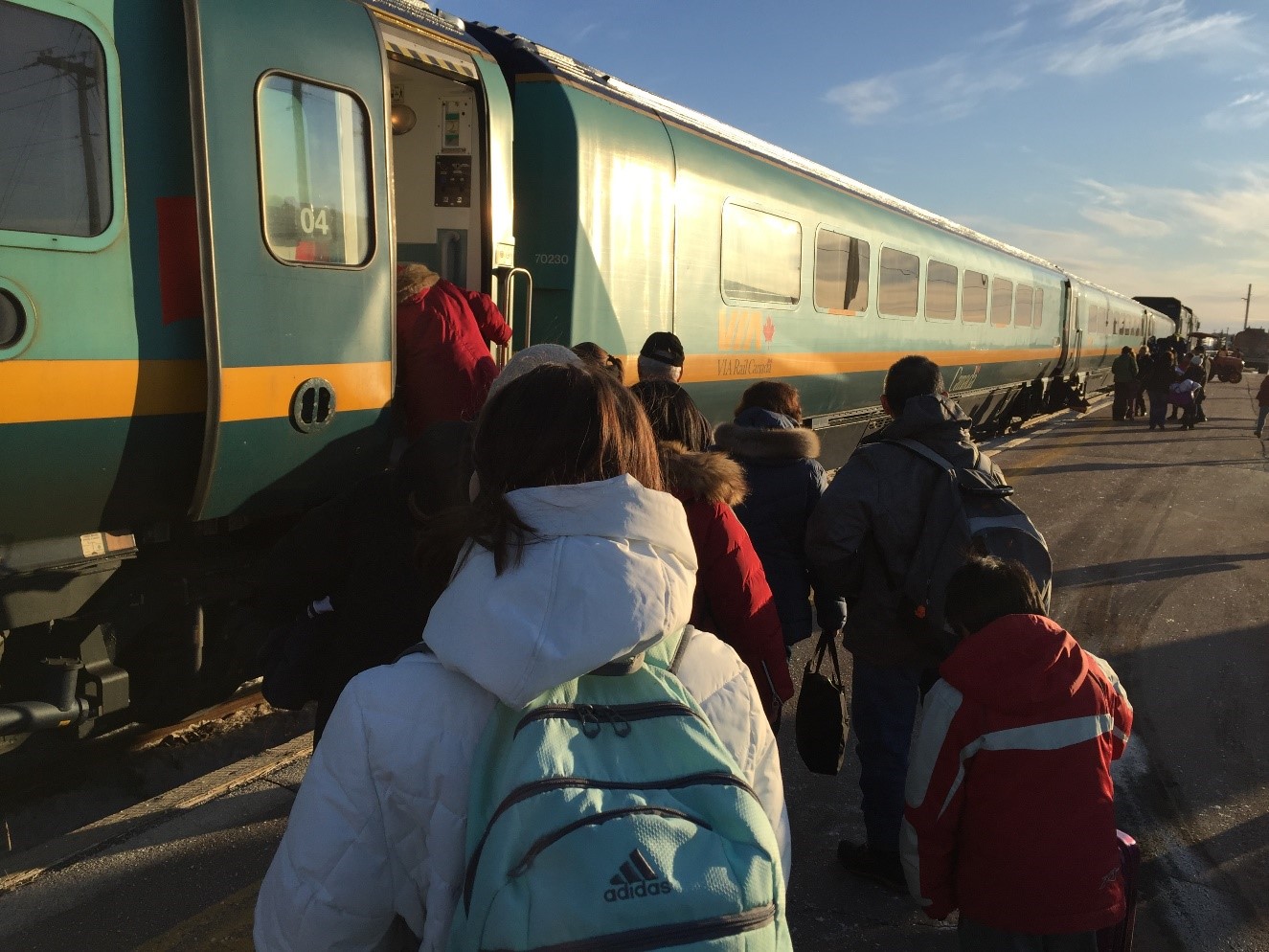
When VIA’s Ocean returns post-pandemic, it will have a different look and feel – and be lacking certain amenities. However, the company is providing few details on its plans for future service, beyond confirming that the train will be back at some point in some form. PHOTO – Tim Hayman

For the second year in a row, VIA’s Annual Public Meeting was an entirely virtual affair, featuring a pre-recorded video update from CEO Cynthia Garneau and other senior VIA management. The 22-minute video, which can be found on both YouTube and the VIA Rail website, offered little by way of specific details, but the overall message was clear – 2020 was an extremely unusual and difficult year for VIA, and the railway isn’t out of the woods yet. Recently released annual and quarterly reports tell much the same story, with ridership plummeting through 2020 as the combination of rail blockades and the pandemic restricted travel and curtailed most of VIA’s services. Still, with the first of the new trains for the Corridor nearly ready to arrive for testing and vaccination roll-outs moving at full speed across the country, there are some reasons to have optimism about things improving in the near future. 

At the time of writing, the Ocean is currently suspended through the end of July 2021. However, with vaccinations continuing at a rapid pace and the various Atlantic provinces unveiling reopening plans that could see less restricted travel from the rest of the country by late July or early August, there is actually some hope that this could really be one of if not the last extensions of the now nearly 16-month service suspension. At TAA’s recent AGM, Philippe Cannon, VIA Rail’s director of public affairs and government relations, explained that the corporation is continuing consultation with representatives from both the New Brunswick and Nova Scotia governments to discuss when conditions will allow the resumption of service. He did acknowledge, however, that the train won’t be back until border restrictions have been lifted and all parties involved are satisfied that it’s safe and feasible to do so.

In addition to the public meeting itself, VIA provided a Q&A document addressing common questions that were submitted in advance of the meeting. As is often the case, the answers were not as thorough as one might hope, nor do they provide much clarification beyond what was already known. For the Ocean, there’s a reiteration of the plan for a bidirectional train using a mix of Renaissance and HEP equipment, but beyond that the answers offer no new details. Responses about whether any sort of dome car will be in the consist to replace the Park car offer only a look at what may be the case while the pandemic is still a concern (and while the Ocean is still unlikely to be running!), and no forward-looking plan. There is also still no commitment to improve service frequency or track conditions, and no further details about what plans may be in place to replace the rapidly deteriorating long distance train fleet. https://corpo.viarail.ca/sites/default/files/media/pdf/speeches/2021%20Annual%20Public%20Meeting_VIA%20Rail_Q&A_EN.pdf

At the very least, both the comments in the public meeting itself and the Q&A document reiterated a commitment to restore service on the Ocean – albeit at the inadequate tri-weekly schedule in place since 2012 – as soon as conditions allow. One answer in the Q&A document even states that The Ocean is a pillar of VIA Rail’s service offering providing essential intercity travel as well as attracting tourists from around the world. VIA Rail remains committed to serving communities in Eastern Canada, and to a full recovery of this route when conditions will allow it”. Now if only VIA would actually treat the Ocean as though it were the “pillar” that they claim it to be, by making the service offering more attractive and useful to the communities it serves!

-Tim Hayman

TWO VIA STATIONS IN NORTHERN NB FACE DEMOLITION

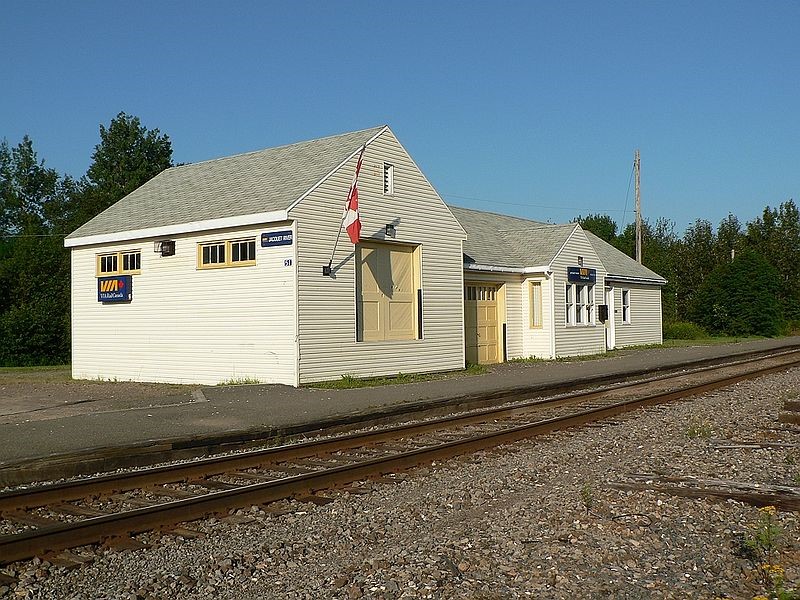
The VIA Rail station in Jacquet River NB is shown in happier times, about 15 years ago, when the Canadian flag was still proudly flown on the property. Unstaffed for many years and with no apparent community interest, the structure is one of two on the Ocean route reportedly slated for demolition. PHOTO – Steve Boyko Collection

Two unstaffed VIA Rail stations in northern New Brunswick are about to be demolished, according to informed sources in the area. The “request stops” for the Ocean at Charlo and Jacquet River, two small communities located between Bathurst and Campbellton, have been unstaffed for many years. The sources are telling TAA that there’s been no apparent interest from either community in taking over the facilities, as has been done with some other stations in the Maritimes and elsewhere where there wasn’t sufficient traffic to warrant the continued presence of VIA employees.

The buildings have reportedly been deteriorating over time, particularly at the Jacquet River location where the roof is said to be in need of major repairs if the building were to be once again made available as a shelter for rail travellers. TAA was not able to confirm reports that tenders had been called by VIA for demolition of the buildings, and at this writing there had been no response to questions directed to the company. It is not known if the Ocean will continue to stop on request at Jacquet River and Charlo when it returns to service post-pandemic.

LIVELY DISCUSSION AT TAA’S VIRTUAL ANNUAL MEETING

Perhaps the current federal government really does believe that Canada ends at Quebec City – at least as far as political influence is concerned. That not-so-encouraging thought was just one of many that emerged during Transport Action Atlantic’s annual general meeting held on May 15. For 2021 the AGM was once again a virtual affair, using the Zoom platform. The now-familiar technology, which admittedly lacks the social benefit of face-to-face contact, does have the advantage of enabling participation by members for whom distance might make attending an in-person meeting difficult or impossible. The online turnout was quite impressive, with representation from all four Atlantic provinces – and beyond.

University of New Brunswick economist Herb Emery told the meeting that the Trudeau Government appears to be firmly focused on the vote-rich territory of Canada’s six largest urban areas. That makes it extremely challenging for smaller cities to get attention, and to reap a fair share of infrastructure funding.

UNB’s Dr. Herb Emery says the Trudeau government is focusing heavily on Canada’s six largest urban centres, to the detriment of smaller cities and rural areas.

TAA’s old familiar refrain that “Canada doesn’t end at Quebec City” would seem to be well directed, Dr. Emery suggested. He senses it will be an uphill struggle to persuade the federal cabinet to invest in “building back better” through climate-friendly projects such as passenger rail and public transit outside the areas of the country that they evidently have identified as priorities.

Meanwhile, the transportation implications of “The Big Reset” – Newfoundland and Labrador’s recently unveiled economic recovery report – were reviewed by TAA board member Tom Beckett. He told the meeting that there are many aspects or opportunities missing or overlooked in the document, noting that the work was directed from the UK by ex-pat Newfoundlander Dame Moya Greene, former head of both Canada Post Corporation and Britain’s Royal Mail, who is known as a strong supporter of privatizing public services.

Included in the report are a suggested 1.5 cents per litre tax on gasoline, a recommendation to support electric car adoption (without the recognition of a need to replace the gasoline tax as electric vehicles become a larger portion of the fleet), an acknowledgement the provincial ferry service is very expensive, and an obvious statement that the provincial road system is quite large and costly to maintain.

One missed opportunity, according to Tom Beckett, is the new ro-ro ferry service between NL and the French enclave of St. Pierre off the island’s south coast, which now can accommodate all vehicles up to and including transport trucks. St. Pierre itself has a trans-Atlantic marine service subsidized by France which has plenty of room on the return crossing.

“This places the EU directly accessible to Newfoundland through Fortune. Live Fortune Bay lobster in Paris, Newfoundland beverage alcohol on the Champs-Élysées, and other products routed to new EU markets. More money in the pockets of Newfoundlanders,” he said. “St. Pierre also has seasonal service by Air France. This provides a spectacular opportunity to draw tourists into the province. Perhaps a strategic private sector partnership orchestrated by government but funded entirely with private sector capital?”

The Big Reset makes no mention of the need to get the 65% cost recovery on Marine Atlantic rates reduced substantially to the benefit of the entire economy, or the significant savings on school busing that could be attained by providing Metrobus passes and service within St. John’s and Mount Pearl. Tom also suggested that significant revenue could be obtained from placing a small toll of perhaps a dollar a trip on the four-lane divided highways in the northeast Avalon which have free alternatives – a concept similar to the 407 north of Toronto. Finally, there is no suggestion of incorporation of transportation elements into the provincial pandemic recovery.

SAINT JOHN AND HALIFAX DIVIDED ON US RAIL MERGER

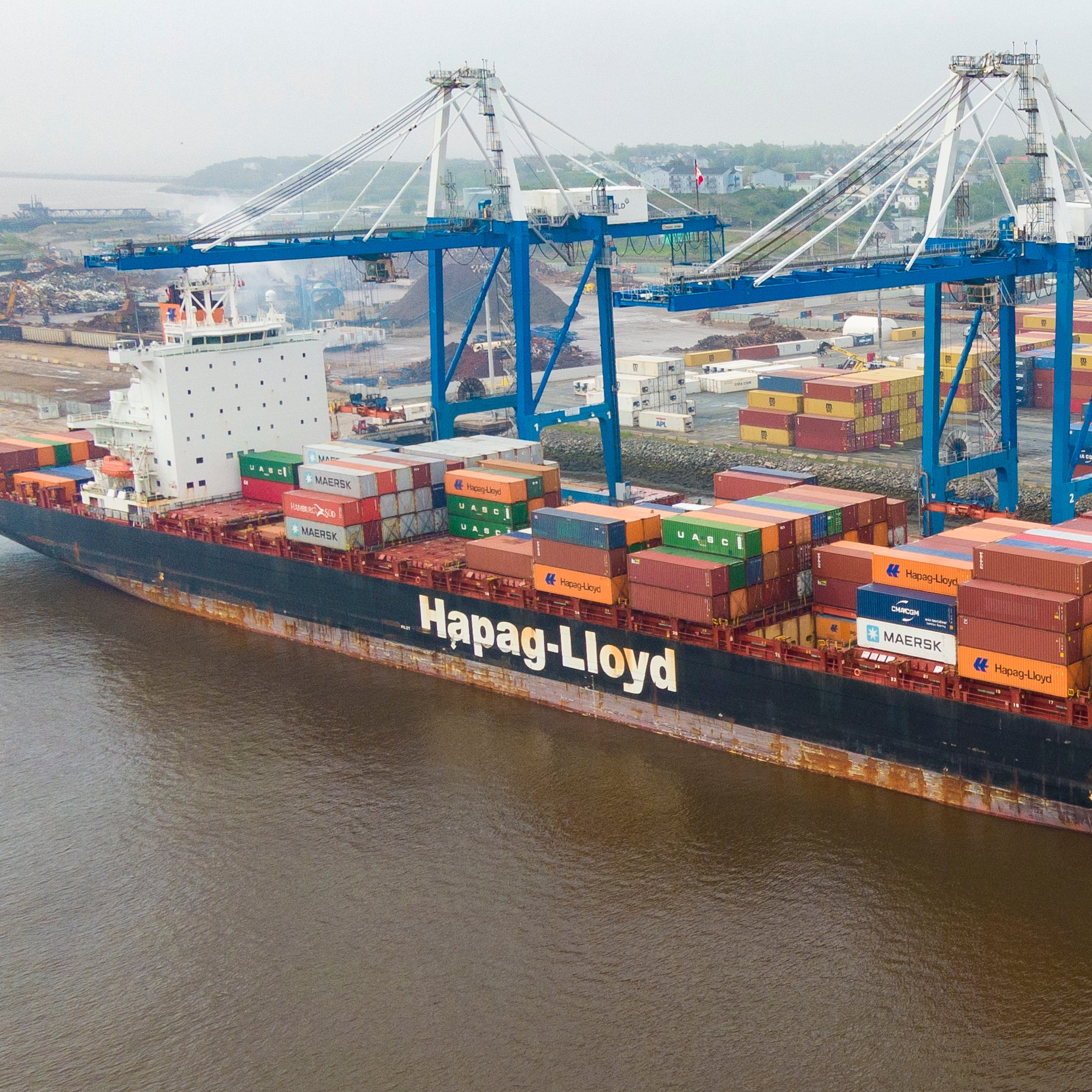
Hapag-Lloyd’s Liverpool Express docked at Saint John on May 27, the first arrival in the shipping line’s new Mediterranean Canada service. CP Rail is heavily promoting its renewed connection with the port (through Irving-owned NB Southern) as part of its “East Coast Advantage”. Saint John is the only port in the Maritimes served by both of Canada’s major railways. PHOTO – Port of Saint John

A multi-billion dollar battle between Canada’s two major railways over a potential merger with smaller US carrier Kansas City Southern has put Atlantic Canada’s two largest seaports in opposing corners. The high-stakes conflict began when Canadian Pacific and KCS made their merger plans known earlier this year. It was too much for arch-rival Canadian National, which promptly countered with a higher bid that was ultimately accepted by the KCS board of directors. CP declined to sweeten its offer, expressing confidence that the CN proposal would not get the approval of US regulators.

Kansas City Southern serves multiple destinations in Mexico, so the merged railway would link all three countries in the North American free trade pact – a substantial competitive advantage.

Some three decades after selling its “short line” to the Maritimes, CP is now once again involved with the Port of Saint John in a big way through its connection with the JD Irving-owned shortline NB Southern. Although CN also runs to Saint John, it is the only railway serving Halifax. As might be expected, both the Nova Scotia government and the Halifax Port Authority are strongly supporting the CN bid.  Premier Iain Rankin has written a letter backing CN’s proposal.

“Any growth in the CN network is a growth opportunity for the Port of Halifax,” said port CEO Capt. Allan Gray in an interview with CBC News. “We’re reaching deeper into the U.S. market. So this is a whole new market space for the Port of Halifax.”

Meanwhile, New Brunswick Premier Blaine Higgs has written to US regulators, urging them to reject the CN bid.

UNCERTAINTY SURROUNDS ATLANTIC BUBBLE

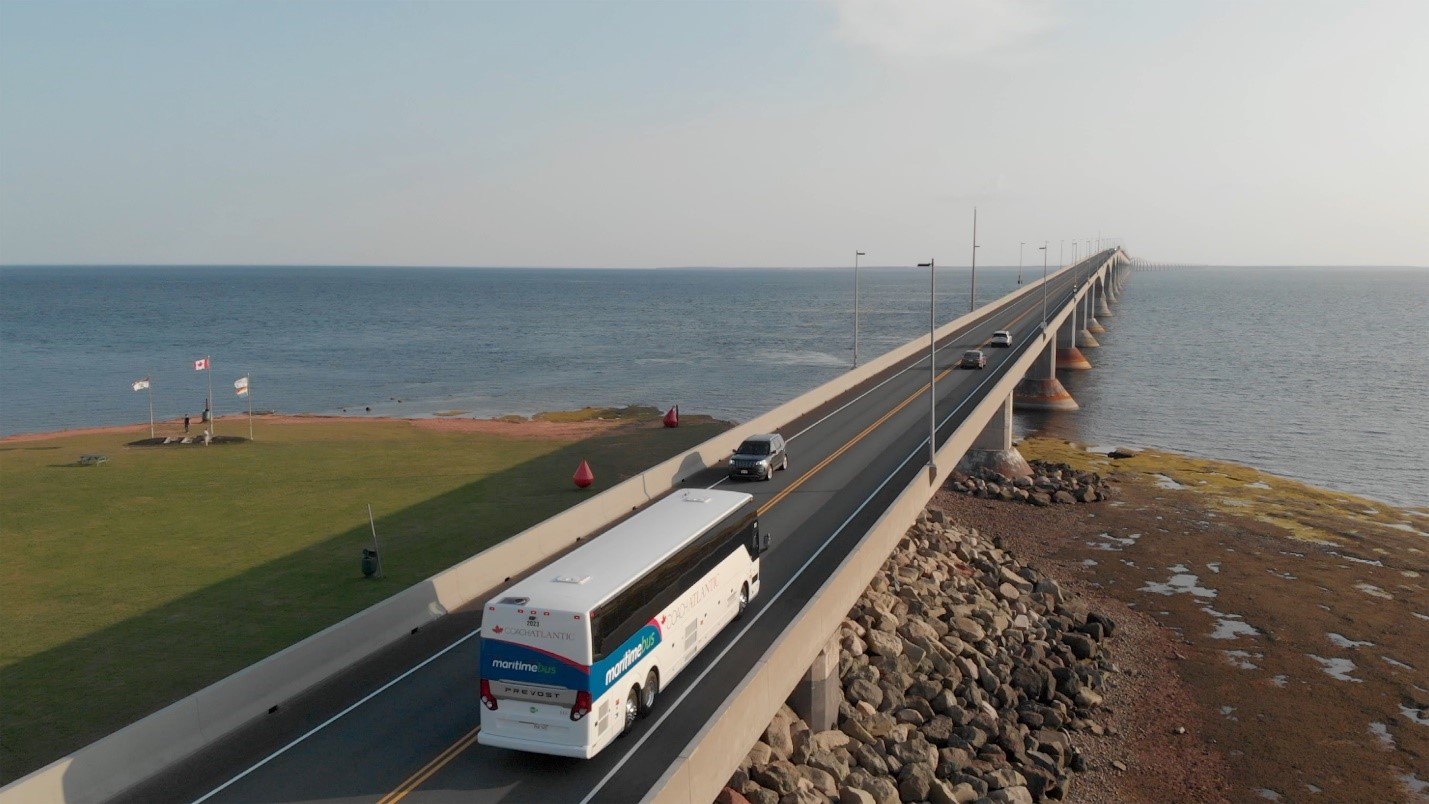
The four Atlantic provincial governments seem to be on different pages when it comes to an Atlantic Bubble agreement for summer 2021. While NB appears poised to allow visitors from PEI without quarantine in the first half of June, crossing Confederation Bridge in the reverse direction without restriction may not be possible until much later. NS and NL also have varied recovery plans that threaten to complicate summer travel between provinces. PHOTO – Maritime Bus

With summer in the air, an Atlantic Bubble that would permit unrestricted travel among the four provinces is far from a done deal. Originally planned to launch on April 19, the agreement that was so successful in 2020 has now been postponed twice. The sudden and severe third wave of COVID-19 in Nova Scotia truly upset the apple cart, and blossom time was devoid of out-of-province visitors. In fact, for most of May even travel between adjacent communities in the fabled Annapolis Valley or elsewhere in NS was prohibited.

As the calendar turned into June, the overall case count in the region had improved considerably, but each provincial government seemed intent on a different path for return to normalcy. On June 1, NS was reporting 369 active cases – down by nearly half from the beginning of May. It had peaked at well over 1500 at mid-month. NL reported 90 cases – up from 33 on May 1 – resulting from outbreaks in the central and western regions of the province. NB’s count was essentially unchanged at 142, while PEI had only four cases, down from 12 a month earlier.

In 2020 a remarkable spirit of co-operation led to a highly-successful four-province agreement that attracted national attention. By allowing freedom of movement at a time when COVID case counts were relatively low throughout the region, many tourism operators were able to salvage at least something from the summer and fall seasons. Despite a few bumps in the road, Atlantic Canada is still in a relatively good situation, but some alarming occurrences since late last year have apparently made officials and politicians nervous. In addition, there are two new premiers who are still feeling their way through difficult times. In Nova Scotia, Iain Rankin is being quite cautious about opening his province to visitors, while Premier Andrew Furey seems to have yielded somewhat to tourism industry advocates who want to see NL opened to the rest of Canada this summer. However, barring a change of heart, it would appear that visitors from Ontario won’t be able to travel through Nova Scotia to get to Newfoundland. There’s also an evident lack of reciprocity between New Brunswick and PEI. And the situation seems to get ever more complicated as the peak travel season approaches. The earliest suggested date for a 2021 Atlantic Bubble is now July 1 – but that’s certainly not carved in stone.

All this has serious implications for transportation companies, as well as tourism operators. There have already been postponements of announced start-ups and restarts of air services around the region, motorcoach services in the Maritimes remain on a four-days-per-week schedule and the line-haul operator in Newfoundland says it may have to shut down entirely by the end of June if some financial relief isn’t forthcoming. Meanwhile, VIA Rail has confirmed that its return to service in the region will not happen until travel restrictions between Quebec and New Brunswick are lifted.

A Vision for Public Transportation in the Maritimes

We can get there from here – it just takes co-operation

By David Coon

The old saying in downeast Maine that says, “You can’t get there from here,” nearly became reality for people needing to travel between northern and southern New Brunswick last month, unless they could drive. 

The federal Crown corporation that provided passenger rail service between Campbellton, Moncton and Halifax stopped its trains from venturing east of Quebec last year.  Next, PEI-based Maritime Bus came close to taking its buses off the road as the pandemic ate into its ridership.  An 11th hour decision by Premier Higgs to provide a $750,000 grant kept the bus links between Fredericton and Edmundston, Moncton and Campbellton, and Fredericton and Moncton, for now.

In the extreme southwest of the province, the Higgs government has been funding the tiny summer tourist ferry between Campobello Island and Deer Island to provide service through the winter. This enables Campobello residents to avoid the long trip through the hot zone that America has become, while providing a link to the island for mainlanders who can no longer cross into the U.S.  Service is spotty since it was never designed for the wind and seas that winter brings.

How has our public transportation network become so fragmented and brittle?  Like Grand Manan and Deer Island, Campobello was once linked by ferry to the mainland. Commuter trains linked Fredericton and Saint John. Daily rail service linked North with South. Bus service was available just about wherever you lived.

The need for public transportation services is growing with an aging population, the rising cost of vehicle ownership and insurance, increasing numbers of immigrants, the regionalization of public services, and the imperative of cutting transportation-related carbon pollution.

With public transportation services in disarray, it’s as if there is no one in charge – which there isn’t.  In fact, the Department of Transportation and Infrastructure has no mandate to oversee the coordination of public transportation services. No civil servant has that turf. New Brunswick has only ever had a highway strategy. There has never been an integrated transportation strategy. 

This partly explains why New Brunswick hasn’t touched a dime of the $120 million in federal funding for public transportation projects allocated to the province as part of the ten-year $673 million infrastructure agreement that was signed with Ottawa in 2018.

There was no one to provide advice on how the transportation funding might be tailored to meet New Brunswick’s needs.  A ten-year public transportation strategy written for government, on the initiative of the Economic and Social Inclusion Corporation, could have provided guidance, but it was gathering dust on a shelf.  The infrastructure agreement with Ottawa got inked with $120 million for public transportation restricted for use by city transit services alone.

The Premier wants us to become more self-sufficient, but if you can’t afford to own a vehicle or are unable to drive one, that self-sufficiency becomes an impossible goal.  Just as deep cuts to our carbon footprint are impossible without shifting driving time to commuting time on a bus or train. 

To achieve our social, economic and environmental goals we must become more self-sufficient in public transportation.  How do we build a public transportation network that meets our needs, and what revenue will fund the necessary public investments?

This is a job for a public institution that crosses provincial borders.  I propose the creation of a Maritime Transportation Authority, a regional Crown corporation, that can quarterback the development of a public transportation network that enables us to travel where we need to go, when we need to go, throughout the Maritimes. 

I envision a seamless system of regional passenger rail, motor coach, and local transit services that are a mix of private, public and community enterprises.  We already have PEI-based Maritime Bus delivering some bus services, which could be expanded.  There are community-based transit services in some areas, ferry services in others, but no rail.  It is time for a Maritime rail service to be knitted into the mix. One ticket should get you where you want to go, from door to door.  Carbon tax revenues can help support operational costs.

Prime Minister Justin Trudeau is promising to spend nearly $15 billion on public transportation over the next eight years.  Let us seize that opportunity for the Maritimes, together, to increase the well-being of our citizens and propel us toward a greener economy by breathing life into a serviceable public transportation network that we can count on to get us there from here.


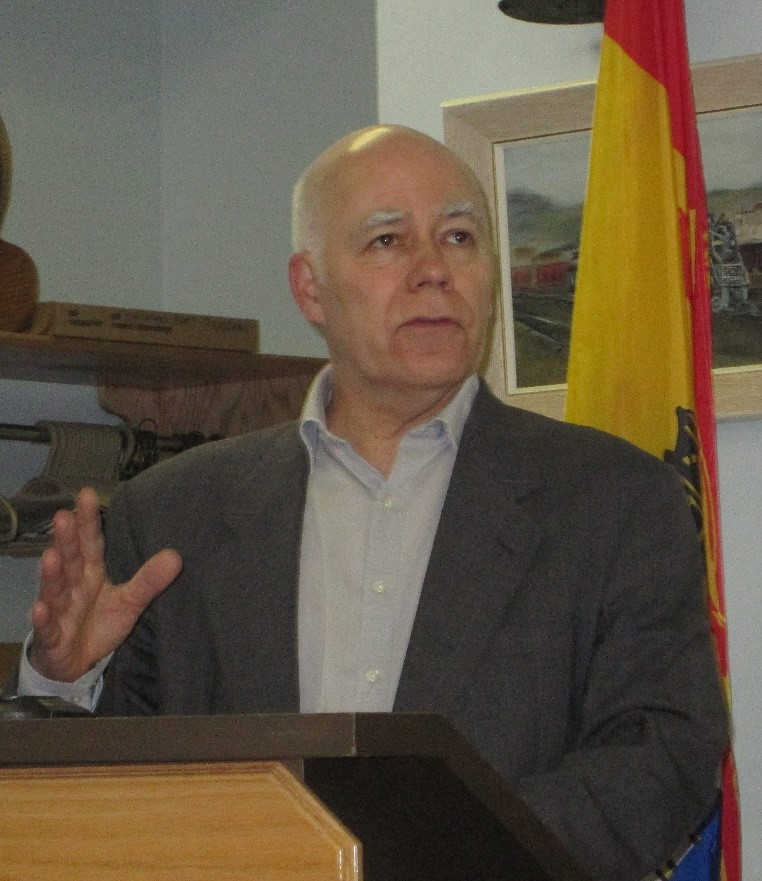
David Coon is leader of the New Brunswick Green Party and the MLA for Fredericton South. He is shown here addressing TAA’s annual general meeting in 2017.

Atlantic Transport News – February 2021

Welcome to the February edition of Atlantic Transport News!

Here’s a look at what you’ll find in this edition:

NORTHERN NEW BRUNSWICK MOTORCOACH SERVICE SAVED

With Jacques Pelletier at the wheel, Maritime Bus departs Moncton for Campbellton on the afternoon of February 1. This essential service for residents of northern New Brunswick will keep rolling through 2021, after a last-minute deal was reached among the bus company and three levels of government. 

New Brunswickers in the northern part of the province will continue to benefit from motorcoach passenger and parcel service through the remainder of 2021, after an eleventh-hour solution involving Maritime Bus and three levels of government was reached. Faced with mounting operating losses, the bus operator announced indefinite closure of its services between Moncton and Campbellton and Fredericton and Edmundston, effective January 15, unless the provincial government was prepared to lend a helping hand. The deadline was subsequently extended to month-end to allow more time for a solution to be worked out.

Although the governments of Nova Scotia and Prince Edward Island had declared their willingness to offer financial support to keep buses running through the pandemic, Premier Blaine Higgs refused to contribute, saying his government wasn’t going to fund for-profit corporations. The position ignored the harsh reality that the company lost nearly $4 million on its line-haul operations in 2020 because of COVID-19 – not to mention the massive revenue losses when its charter operations were brought to a standstill by the pandemic.

Under pressure from a wide variety of interests (including Transport Action Atlantic), the government finally backtracked. In a rare display of non-partisan solidarity, 21 senators from the Maritime provinces signed a letter to the Prime Minister urging help for the struggling bus industry. With a federal government contribution under the Safe Restart program on the table, the Province allocated some money through its Regional Development Corporation, and saved face by transferring the provincial share to the City of Edmundston to be passed on to Maritime Bus.

The northern municipalities, although pleased that a solution has been reached, were less than satisfied with the process. Apparently, this money was diverted from funding that the RDC was already holding for eventual distribution to towns and cities under the Safe Restart agreement, so the already cash-strapped municipal coffers were in effect paying for what they viewed as a provincial responsibility.

Mike Cassidy of Maritime Bus credits Local Government Minister Daniel Allain and Frédérick Dion of the Federation of Francophone Municipalities with brokering the eventual outcome, with the support of the senators and federal Intergovernmental Affairs Minister Dominic LeBlanc. Curiously, the Department of Transportation and Infrastructure apparently wasn’t involved in the process at all.

Mr. Cassidy tells TAA that the level of political action in all this was incredible, commenting that it isn’t right to be so involved with politics when you are trying to save your company and industry, especially after the other two provinces agreed participate. Meanwhile, he is deeply concerned about the future of the motorcoach industry nation-wide, and is working with other operators to promote bus connectivity across Canada for both passengers and parcels post-COVID.

“Governments must understand that busing is part of the mobile infrastructure,” he says, adding that the first step should be getting all the provinces to co-operate in building back a cohesive coast-to-coast network.

MARINE ATLANTIC RATES INCREASED AGAIN

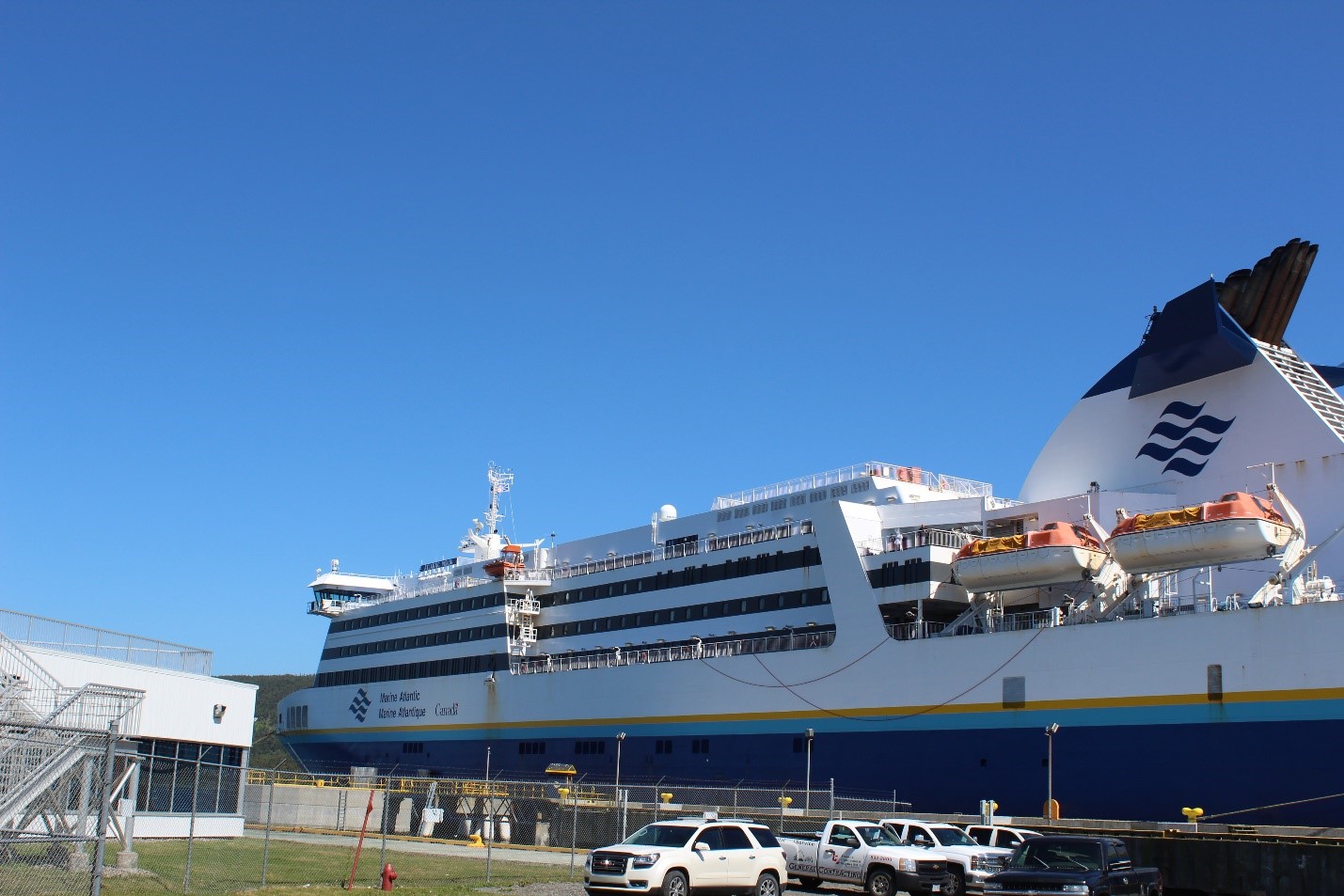
If you’re planning on taking Marine Atlantic’s Argentia ferry this summer, it’s going to cost you more. The Crown corporation has announced that most of its rates will be increasing as of April 1, in order to satisfy Transport Canada demands for 65% cost recovery.

It appears that Transport Canada is totally without mercy in its demands for 65% cost recovery on the constitutional Newfoundland ferry service provided by Marine Atlantic – global pandemic notwithstanding. On February 1 the federal Crown corporation announced that most of its rates would be going up at the start of the next fiscal year, beginning in April. A company spokesman told NTV News that Marine Atlantic had failed to meet its financial targets in 2020 because of dramatically reduced passenger revenues, and had no option but to aim for making up the shortfall in 2021.

There will be no increase in passenger and passenger vehicle rates on the North Sydney- Port aux Basques route, but both passenger and commercial users of the seasonal Argentia route (where Transport Canada requires full recovery on marginal costs) will pay 2.5% more. That, of course, assumes that the service actually runs this summer. It was cancelled entirely for 2020, but reservations are now being accepted for two round trips a week beginning in late June, with the possibility of a third sailing being added should demand materialize.

But far more critical is the two percent increase for commercial traffic on the company’s main route to Port aux Basques, coupled with a 3.4% hike in the drop trailer management fee. This is expected to have a noticeable impact on the cost of living on the island, as a large proportion of groceries and everyday household needs as well as building supplies are carried by drop trailers.

For the hospitality industry the fare hike comes at a particularly inopportune time. In the aftermath of COVID-19, with air transportation in serious crisis and unlikely to recover in the near future, affordable ferry service will be particularly important to the struggling tourism sector. If the Atlantic Bubble is restored by summer 2021, Marine Atlantic will be uniquely positioned to bring significant numbers of visitors from the Maritimes – if the price is right.

With no expectation the rate increase was imminent, Transport Action Atlantic had already initiated an effort to get ferry rates on the table as an issue in the February 13 provincial election. Although the service is clearly a federal responsibility, TAA believes the issue will only be addressed if there is a strong protest from provincial politicians. Accordingly, the parties had been asked to present their positions by answering two questions:

  • Does your party support the principle that the ferry service between Port aux Basques and North Sydney is a part of the Trans Canada Highway, and as such the cost to users should be comparable to travelling the equivalent distance by road?
  • Regardless of the outcome of the February 13 provincial election, will your party demand a full review of the existing Marine Atlantic ferry rates to ensure that the Government of Canada is compliant with the spirit of the 1949 Terms of Union?

TAA plans to post any responses received on its website prior to polling day.

ANOTHER SEASON LOST FOR BAR HARBOR FERRY

The Cat will sit idle for another year, as the full 2021 ferry season has been cancelled. PHOTO – Tim Hayman

It will be at least another year until the international ferry service between Yarmouth and Maine resumes. On February 1, the provincial government announced that the entire 2021 sailing season would be cancelled, citing ongoing COVID concerns, continued international border restrictions, and the likelihood that a critical percentage of the general population will not be vaccinated until the summer. The move is anticipated to save on certain costs such as marketing and season preparations and hiring crew, which would otherwise have taken place if the season was scheduled and later postponed or canceled. Still, there will be certain fixed costs to keep up basic maintenance and infrastructure work in the interim.

This will be the third year in a row that the high-speed Cat ferry will sit idle. The service for the 2019 season was slated to move its American terminus to Bar Harbor after previously serving Portland, but the move ran into hurdles with the completion of the new American facility, resulting in repeated postponements and then full cancellation of the season. With the terminal then complete, the 2020 season was anticipated to see a return, but COVID restrictions once again caused postponements and an eventual cancellation of the full season.

The absence of the ferry service has continued to be a blow to the tourism industry in southwest Nova Scotia, though as COVID continues to restrict non-essential travel, those challenges will persist with or without the ferry in operation. Hopefully the 2022 season will find the region (and the broader world!) in better shape.


AIRPORTS PLEAD FOR HELP AS SERVICE CUTBACKS CONTINUE

Graphic by James Fraser

Just when we thought the air travel situation in Atlantic Canada couldn’t get much worse – it did. Just days after indefinitely suspending all service from Sydney and Saint John, Air Canada added Fredericton to its no-fly list. As of January 23, the only airport in New Brunswick with scheduled passenger service is Moncton. And, on the same date, the direct Air Canada service between Toronto and St. John’s which had existed for decades came to an end.

The cutbacks in scheduled service have had a drastic effect on all airport authorities in the region.  Even for those now deserted by Air Canada and WestJet, the bills still have to be paid as the runways must be kept open for general aviation and emergency medical flights. The total revenue loss for 2020 among members of the Atlantic Canada Airports Association is estimated a $140 million, which the ACAA says will have a substantial impact on cash flow and future financial viability, with a severe trickle-down effect on the respective communities. They’re asking for federal government help to keep the lights on while they await the end of the pandemic. But even then, they aren’t expecting a rapid recovery.

Meanwhile, a retired airline executive told CBC News that he isn’t anticipating a quick resumption of the cancelled services once the pandemic subsides. Duncan Dee, former COO at Air Canada, said reactivating idle aircraft and personnel takes time, adding that he suspects management will take a “wait and see” attitude and evaluate demand at Moncton before making a decision on other New Brunswick airports.

The chambers of commerce in New Brunswick’s three largest cities are not content to wait. They’ve joined together in a united campaign to oppose those who suggest that single airport scheduled passenger service for the entire province may the way of the future. That possibility was raised in the recent provincial budget speech.  Moncton, Fredericton and Saint John were all profitable airports pre-pandemic, with a combined economic impact of $765 million, the chambers note, insisting that economic prosperity demands that scheduled service be returned to all three as the public health threat subsides.

The one airline that seems to be bucking the pandemic trend has been forced to adjust its services from Moncton to Newfoundland and Labrador to accommodate the latest round of travel restrictions. St. John’s-based PAL Airlines has abandoned its service between Charlo NB and Wabush NL, and combined it with a new route linking Moncton with Deer Lake. And, until interprovincial travel restrictions are eased, non-stop service between YQM and YYT has been temporarily eliminated. As of January 10, a tri-weekly DASH-8-300 is flying St. John’s – Deer Lake – Moncton – Wabush and return. PAL’s Janine Brown says a daily St. John’s – Moncton – Ottawa routing is still their post-pandemic objective, with a separate service planned for Deer Lake and Wabush.

VIA SERVICE WON’T BE BACK BEFORE MID-MAY

It will be May 15 at the earliest before VIA Rail’s Ocean again pulls out of Montreal’s Gare Centrale – and likely not even then if interprovincial pandemic travel restrictions are still in place.

In what continues to be a pattern fitting of Groundhog Day, VIA has extended the cancellation of the Ocean through at least May 15, 2021. This continues the rolling pattern of recent months, where bookings for the next few months were first blocked and then outright cancelled as time approached. It also now guarantees that the earliest possible service resumption on the east coast will be the beginning of what would normally be the peak season for the year, though it’s unlikely to be anything resembling the normal travel season, and leaves Atlantic Canada without passenger rail service for more than a year. It still remains to be seen what exactly the service offering will look like when the train does resume.

The exact date that service will actually resume still remains unclear. The passenger carrier continues to insist that it intends to resume service when it is safe to do so, but it is likely that this date will be dependent on when travel restrictions between Quebec and the Atlantic provinces ease – and that remains heavily dependent on COVID case numbers and dynamics between the provinces.

VIA has also extended the modified service offering on the Canadian, with only one weekly departure west of Winnipeg and heavily modified onboard services, through the middle of May, and the Winnipeg-Churchill’s economy-only service will also continue through that time. Meanwhile, further Corridor service reductions have rolled out in recent weeks in light of further restrictions in Ontario and Quebec. It’s clear all across the country that the interruptions to VIA will be here for some time yet.


TAA AWARD HONOURS TRANSIT AND MOTORCOACH DRIVERS

Metrobus operator Amy Bonnington is one of hundreds of transit and motorcoach drivers who’ve kept essential public service rolling throughout the pandemic. Transport Action Atlantic has collectively honoured all of them with the 2020 John Pearce Award.

Transit systems throughout the region continue to struggle under the pandemic burden of greatly reduced ridership revenue coupled with higher operating costs. But they were pleased to receive a bit of recognition from Transport Action Atlantic recently. TAA has decided to confer its John Pearce Award for 2020 collectively on all the transit and motorcoach drivers throughout the four provinces who have continued to report for duty without interruption during COVID-19 in order to transport essential workers to their jobs and ensure mobility within their communities. They faithfully fulfilled their daily responsibilities, and not without significant risk to their personal health and safety despite all the precautions that had been put in place.

“Halifax Transit’s bus operators and ferry crews’ pride in public service during COVID-19 has been exemplary,” said Dave Reage, director of Halifax Transit. “I am so proud of their ongoing commitment to our customers and community. Throughout these challenging times, they have worked together to keep Halifax moving!”

Judy Powell, general manager of Metrobus Transit in St. John’s commented “During this difficult time, they put our customers ahead of themselves to ensure the people of our communities could access essential goods and services.”

The John Pearce Award is given annually to recognize an outstanding contribution to the public transportation cause. It was created by TAA in 2017 to commemorate the lifetime achievements in public transportation advocacy by the late Mr. Pearce, a founding father of the association’s predecessor Transport 2000 Atlantic, a past president, and long-time member of the board.